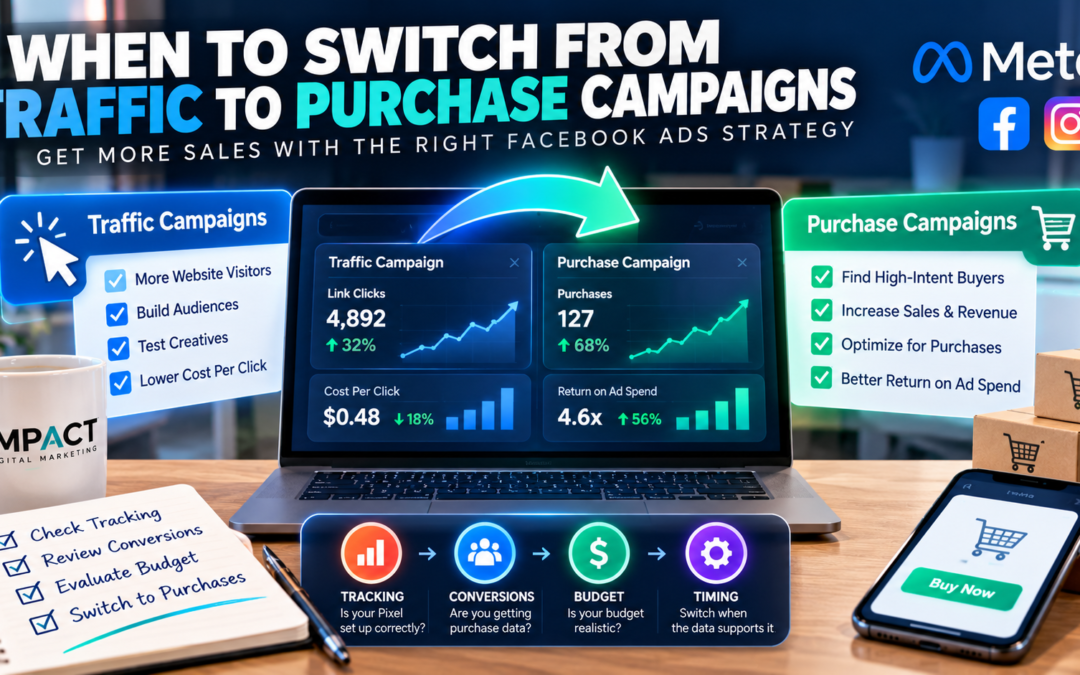
Knowing when to switch from traffic to purchase campaigns in Facebook Ads can prevent businesses from spending money on clicks that never turn into customers. However, there is no universal rule requiring advertisers to run a traffic campaign for a specific number of days before optimizing for purchases.
Meta optimizes ad delivery around the action you select. A Traffic campaign generally looks for people likely to click or visit a destination, while a Sales campaign can optimize toward people more likely to complete the conversion event you select.
For many businesses, the better question is not simply how long to run a traffic campaign. Instead, you should determine whether your tracking works correctly, whether your website converts visitors, whether Meta is receiving useful conversion signals, and whether you have enough budget to optimize toward your actual business goal.
Understanding Facebook Ads purchase campaign timing can help you decide when traffic campaigns still serve a purpose and when it makes more sense to optimize directly for sales.
At Impact Digital Marketing, we evaluate Facebook and Instagram advertising based on measurable business results such as leads, appointments, purchases, and customer acquisition—not clicks alone.
Traffic Campaigns vs. Purchase Campaigns: What’s the Difference?
Before deciding when to switch from traffic to purchase campaigns, it is important to understand what you are asking Meta to optimize.
A Traffic campaign focuses primarily on generating actions such as link clicks or landing page views. A Sales campaign allows advertisers to optimize toward conversion events associated with sales, including purchases when appropriate.
Those objectives can attract different user behavior.
If your real goal is purchases, inexpensive clicks do not necessarily indicate a successful campaign. A person who frequently clicks advertisements is not automatically the same person who frequently buys products online.
Landing Page Views vs. Purchase Optimization
Landing page views can be useful when you want people to visit and load a webpage. They can also help businesses test advertisements, landing pages, offers, or website functionality.
Purchase optimization has a different objective: finding opportunities to generate the conversion event that matters to the business.
That distinction is critical when evaluating Facebook Ads purchase campaign timing.
Do You Need to Start With a Facebook Traffic Campaign?
No. A business does not automatically need to start with a Traffic campaign simply because its Meta advertising account or Pixel is new.
If your actual goal is purchases and your tracking works correctly, optimizing toward the desired conversion can often make more strategic sense than spending weeks optimizing exclusively for clicks.
Traffic campaigns still have legitimate uses. You might use them to:
- Generate website visits
- Promote educational content
- Test landing-page engagement
- Build certain website audiences
- Drive visitors when traffic itself is the campaign goal
But businesses should avoid assuming that accumulating inexpensive clicks automatically trains Meta to generate purchases later.
How Does the Meta Pixel Learn From Website Activity?
The Meta Pixel records website events that you configure, such as PageView, ViewContent, AddToCart, InitiateCheckout, Lead, and Purchase.
Those signals can provide Meta with information about actions occurring after people interact with your marketing.
However, the idea that advertisers must “season” a Pixel with a fixed number of traffic clicks before running a Sales campaign can oversimplify how modern Meta advertising works.
Your priority should be accurate event tracking and sending Meta meaningful conversion signals.
When to Switch From Traffic to Purchase Campaigns
You should consider when to switch from traffic to purchase campaigns based on campaign goals and performance rather than an arbitrary calendar date.
If purchases are your real objective, evaluate these factors:
- Is your Meta Pixel installed correctly?
- Is the Purchase event firing correctly?
- Are purchase values being reported accurately?
- Is your landing page functioning properly?
- Does your website generate purchases from other traffic sources?
- Is your advertising budget realistic compared with your expected cost per purchase?
- Does your ad clearly match the landing-page offer?
If these fundamentals are working, you may not need an extended traffic phase before testing purchase optimization.
Facebook Ads Purchase Campaign Timing: What Matters Most?
Effective Facebook Ads purchase campaign timing depends more on data quality, conversion volume, budget, and the economics of your offer than on reaching Day 14 or Day 30.
For example, one business could generate meaningful conversion data within several days. Another business selling a much more expensive product could require considerably longer.
Instead of following a rigid timeline, monitor the relationship between:
- Advertising spend
- Website traffic
- Add-to-cart activity
- Checkout activity
- Purchases
- Cost per purchase
- Purchase value
- Return on ad spend
These signals provide a much better picture of campaign readiness than traffic volume alone.
What Is the Meta Ads Learning Phase?
Meta’s ad delivery system goes through a learning period when an ad set begins delivering or after certain significant changes.
During this period, the system explores how best to deliver advertisements based on the selected optimization event, audience, creative, placements, budget, and other campaign settings.
Performance can fluctuate during learning, so advertisers should avoid making unnecessary changes every few hours simply because early results vary.
What About the 50 Optimization Events Rule?
Meta has historically used approximately 50 optimization events within seven days as an important benchmark associated with the learning phase.
However, advertisers should not treat that number as a requirement that prevents them from optimizing for purchases until they already generate 50 purchases every week.
A campaign can still generate profitable results without reaching that volume.
The practical issue is that lower conversion volume gives Meta fewer examples of the action you want, which can make optimization more difficult or performance less stable.
Should You Optimize for Add to Cart Before Purchases?
Sometimes, but not automatically.
If purchases happen too infrequently for meaningful optimization, advertisers may consider whether a higher-volume event such as InitiateCheckout or AddToCart provides useful information.
However, there is an important tradeoff.
When you optimize for Add to Cart, you are asking Meta to find people likely to add products to their carts—not necessarily people most likely to complete purchases.
Therefore, moving higher in the funnel should be a strategic decision rather than a mandatory step in every account.
What If Your Purchase Campaign Has Very Little Data?
If your campaign generates few or no purchases, do not immediately assume the Pixel needs more traffic.
Investigate the entire conversion path.
Potential problems can include:
- Weak advertising creative
- Poor audience-to-offer fit
- Uncompetitive pricing
- Slow website performance
- Confusing product pages
- Unexpected shipping costs
- Difficult checkout process
- Tracking problems
- Insufficient budget
- A product with a long buying cycle
Finding the actual bottleneck is more valuable than simply purchasing additional traffic.
Make Sure Meta Purchase Tracking Works Correctly
Before increasing spending, verify that Meta receives accurate conversion information.
A purchase campaign cannot be evaluated properly if completed transactions are missing or duplicated.
Advertisers should verify that the Purchase event fires at the appropriate point and that important parameters, including transaction value and currency where applicable, are transmitted correctly.
Meta Pixel and Conversions API
Many businesses use the Meta Pixel together with the Conversions API to improve the reliability of event measurement.
The browser-based Pixel can capture website activity, while Conversions API can send eligible event data from a server or another connected platform.
When both methods report the same event, proper event IDs and deduplication are important so Meta does not count one purchase twice.
What Is Meta Event Match Quality?
Event Match Quality helps indicate how effectively customer information associated with an event can be matched with Meta accounts.
Improving the quality and completeness of eligible customer information can support measurement and event matching.
However, advertisers should not treat one Event Match Quality score as a universal guarantee of advertising performance.
Tracking accuracy, event setup, creative quality, offer strength, website conversion rate, and campaign economics all matter.
High Click-Through Rate but No Sales: What Does It Mean?
A high click-through rate with few or no purchases often indicates that the problem occurs somewhere after the advertisement gets attention.
Start by auditing the post-click experience.
Check the Message Match
Your landing page should clearly continue the promise made in the advertisement.
If the advertisement promotes a specific product, discount, benefit, or offer, visitors should immediately recognize it after arriving on the page.
Look for Unexpected Costs
Shipping charges, taxes, fees, or other unexpected expenses can cause customers to abandon checkout.
Review your checkout experience and determine whether customers encounter surprises after showing strong purchase intent.
Check Mobile Page Speed
Facebook and Instagram users frequently browse on mobile devices.
If an advertisement generates clicks but the landing page loads slowly or performs poorly on a phone, potential customers may leave before seeing the offer.
Evaluate the Offer
Sometimes the advertisement works perfectly—the offer simply does not convert.
Review your pricing, product positioning, competitive alternatives, trust signals, reviews, guarantees, shipping terms, and overall value proposition.
Do Not Judge Facebook Ads by Cheap Clicks Alone
Cheap clicks can look impressive inside Ads Manager while producing very little revenue.
For an e-commerce business, useful metrics may include:
- Cost per purchase
- Purchase conversion value
- Return on ad spend
- Add-to-cart rate
- Checkout completion rate
- Landing-page conversion rate
- Average order value
The campaign should ultimately be judged according to the business outcome it was designed to produce.
How Much Budget Does a Purchase Campaign Need?
There is no universal Facebook Ads budget that works for every purchase campaign.
Your budget should make sense relative to your expected cost per acquisition.
If a business expects purchases to cost approximately $50 but spends only a few dollars per day, it may take a long time to collect meaningful purchase data.
Conversely, increasing the budget cannot fix an offer or website that does not convert.
Budget, conversion rate, product economics, and expected acquisition cost need to work together.
How Should You Scale a Successful Purchase Campaign?
Once a purchase campaign produces profitable and reasonably consistent results, scaling should focus on preserving performance while increasing volume.
There is no universal rule requiring every advertiser to increase budgets by exactly 15% or 20% every few days.
Instead, monitor how budget changes affect:
- Cost per purchase
- Purchase volume
- Return on ad spend
- Audience delivery
- Conversion rate
Larger changes can alter delivery and performance, so businesses should evaluate results carefully rather than scaling based on a rigid formula.
Understand Facebook Ads Attribution
Attribution determines how Meta assigns credit for conversions associated with advertisements.
This becomes especially important when customers do not purchase immediately.
A lower-priced impulse product may have a short buying cycle. An expensive product or service may require multiple interactions before the customer converts.
Advertisers should understand the attribution settings available in their account and compare Meta reporting with other business data when evaluating campaign performance.
When Should You Stop a Traffic Campaign?
If your primary objective is sales, consider reducing or stopping a traffic campaign when it no longer serves a specific strategic purpose.
This is another reason when to switch from traffic to purchase campaigns should not be decided by a fixed number of days.
Ask:
- Are these visitors converting?
- Is the traffic campaign helping us test something specific?
- Are we building an audience we actually plan to use?
- Would this budget generate more useful data in a Sales campaign?
If the only justification for continuing the campaign is that clicks are inexpensive, that may not be enough.
A Practical Facebook Ads Objective Transition Strategy
Rather than automatically following a 30-day traffic-to-purchase formula, businesses can use a more flexible process.
Step 1: Define the Real Conversion Goal
Determine whether you ultimately want purchases, leads, appointments, phone calls, or another measurable action.
Step 2: Verify Tracking
Confirm that your Pixel, conversion events, and Conversions API configuration work correctly before evaluating results.
Step 3: Evaluate the Website
Make sure the landing page works well on mobile devices, loads quickly, clearly presents the offer, and provides a simple conversion process.
Step 4: Optimize Toward the Business Goal
If you have reliable purchase tracking and purchases are the actual objective, test purchase optimization rather than assuming you must spend several weeks buying traffic first.
Step 5: Diagnose Low Conversion Volume
If purchases remain limited, evaluate the creative, audience, offer, website, checkout process, budget, and tracking before deciding that the optimization event itself is the problem.
Step 6: Measure Business Results
Compare advertising spend with actual purchases and revenue rather than judging success by clicks alone.
Frequently Asked Questions About Facebook Ads Purchase Campaign Timing
When should I switch from traffic to purchase campaigns?
Determining when to switch from traffic to purchase campaigns should depend on your actual objective, tracking accuracy, website performance, conversion data, and budget rather than an arbitrary number of days. If purchases are your goal and your tracking works properly, you can test purchase optimization without necessarily running a long traffic campaign first.
Should I run Facebook Traffic ads before Sales ads?
Not necessarily. Traffic campaigns can serve useful purposes, but they are not a mandatory prerequisite for Sales campaigns. Choose the objective that best matches what you actually want customers to do.
How long should I run a Facebook Traffic campaign?
There is no universal duration. Run it as long as it continues serving a defined business or testing purpose. If purchases are your objective, evaluate whether spending the same budget on purchase optimization would provide more relevant information.
Do I need 50 purchases before running purchase ads?
No. You do not need to generate 50 purchases before launching a purchase-optimized campaign. Higher conversion volume can provide Meta with more optimization signals, but the commonly referenced learning benchmark should not be interpreted as a prerequisite for starting purchase optimization.
Should I optimize for Add to Cart if I do not have enough purchases?
It can be considered when purchase volume is extremely limited, but remember that Meta will then optimize for people likely to add items to their carts rather than necessarily complete purchases.
Does a new Meta Pixel need to be seasoned?
A new Pixel needs accurate event data, but there is no universal requirement to “season” it with hundreds or thousands of traffic clicks before optimizing for purchases. Accurate conversion tracking and meaningful events are more important than accumulating clicks simply for volume.
Why am I getting Facebook Ad clicks but no purchases?
Possible causes include weak offer-to-audience fit, landing-page problems, slow mobile performance, unexpected costs, checkout friction, tracking errors, insufficient budget, or advertising creative that attracts attention without attracting qualified buyers.
What determines Facebook Ads purchase campaign timing?
Facebook Ads purchase campaign timing should reflect your conversion goal, tracking setup, website performance, purchase volume, expected acquisition cost, and available budget. There is no single timeline that applies to every advertiser.
Build Facebook Ads Around Conversions, Not Just Clicks
The biggest mistake businesses can make is assuming more traffic automatically produces more customers.
Traffic has value when it serves a clear purpose. However, if your business needs sales, appointments, or qualified leads, your advertising strategy should ultimately optimize and measure those outcomes.
Understanding when to switch from traffic to purchase campaigns requires looking beyond an arbitrary Day 14 or Day 30 rule. Accurate tracking, conversion data, website performance, campaign economics, and your actual business objective should guide the decision.
Impact Digital Marketing helps businesses manage Facebook and Instagram advertising alongside website optimization, conversion tracking, SEO, Google Ads, CRM systems, call tracking, and other digital marketing strategies.
Visit Impact Digital Marketing to learn more or schedule a consultation.