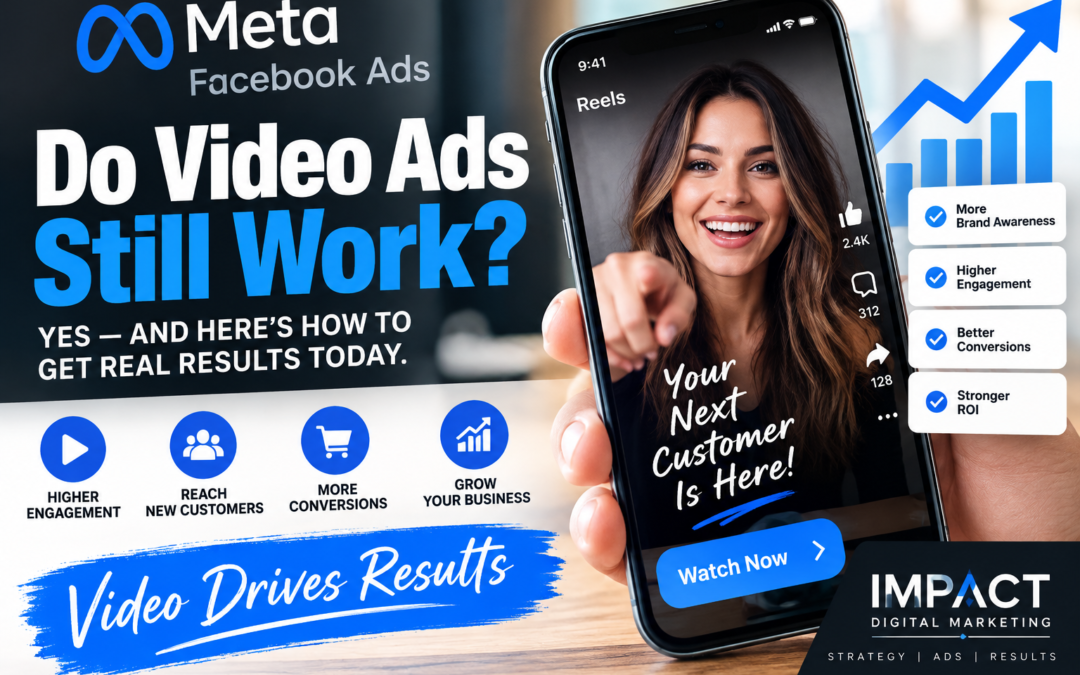
Do Video Ads Still Work in Facebook Ads Today?
Facebook video ad performance remains an important consideration for businesses investing in Meta advertising. If you have been running Meta campaigns for any length of time, you have probably wondered whether video ads still generate strong conversion rates compared with years ago. The answer is yes, but today’s results depend much more heavily on creative quality, audience signals, placement, and a well-planned Meta video advertising strategy.
The days when advertisers could upload a poorly produced video, target a broad audience, and expect inexpensive conversions are largely gone. The digital advertising landscape has matured, user attention has become more fragmented, and privacy changes have altered how Meta collects signals and optimizes campaigns.
That does not mean businesses should abandon video. Video remains a powerful format for capturing attention, demonstrating products or services, educating potential customers, and building trust. Understanding modern Facebook video ad performance requires looking beyond clicks and considering how video contributes to the entire customer journey.
How Facebook Video Ad Performance Has Changed
To understand today’s results, we need to look at how Facebook and Instagram advertising have evolved. Historically, advertisers relied heavily on Meta’s pixel and detailed audience targeting. Advertisers could create narrow audiences based on interests, behaviors, demographics, and website activity.
Privacy changes, including Apple’s App Tracking Transparency framework, reduced some of the off-platform signals available to advertisers. As targeting changed, creative became increasingly important.
Today, the video itself can provide Meta with valuable engagement signals. When someone stops scrolling, watches several seconds, engages with the content, or clicks an advertisement, those actions can help Meta’s delivery system understand which users may find similar content relevant.
This means an effective Meta video advertising strategy should treat creative as part of the targeting process rather than simply as something displayed after an audience has been selected.
Are Facebook Video Ads Still Profitable?
For many businesses, video advertising can still generate profitable results. However, evaluating Facebook video ad performance based solely on immediate last-click conversions can provide an incomplete picture.
Video frequently plays an important role earlier in the customer journey. Someone may watch an advertisement today, remember the company, search for the business later, visit its website, and eventually become a customer.
This makes video particularly useful for:
- Introducing a company to new audiences
- Demonstrating products or services
- Explaining complicated offers
- Building brand recognition
- Generating engagement
- Supporting retargeting campaigns
- Building trust before asking for a conversion
Engagement Rate vs. Conversion Rate
One common mistake is assuming that a highly engaging video will automatically produce strong sales or lead conversions.
Engagement metrics can include video views, watch time, reactions, comments, shares, and the percentage of viewers who continue watching after the opening seconds.
Conversion metrics measure whether viewers complete the business objective, such as submitting a form, booking an appointment, calling the business, or making a purchase.
Strong Facebook video ad performance requires more than getting people to watch. The video should capture attention from the right audience and then guide that audience toward a meaningful action.
Video Ads vs. Static Images
Businesses often ask whether video advertisements outperform static image advertisements. There is no universal winner because each format can serve a different purpose.
Static images can work particularly well for:
- Simple offers that can be understood immediately
- Retargeting campaigns
- Promotions and discounts
- Clear calls to action
- Products that require little explanation
Video ads can be especially effective for:
- Introducing a brand to cold audiences
- Showing how a product works
- Demonstrating a service
- Explaining a complicated offer
- Building trust through testimonials
- Telling a story that would be difficult to communicate with one image
A strong Meta video advertising strategy does not necessarily require choosing one format. Many campaigns can benefit from testing both video and static creative and allowing performance data to determine where the advertising budget should go.
What Types of Facebook Video Ads Convert Today?
The style and structure of a video can have a major impact on results. Modern social media users scroll quickly, which means advertisers often have only a few seconds to earn attention.
Short-Form Video
Short videos can work particularly well for Facebook and Instagram feeds, Stories, and Reels. These videos should communicate the central idea quickly instead of waiting until the end to reveal the offer.
Effective short-form advertising often includes:
- A strong opening hook
- A clearly defined problem
- A simple solution
- Visual demonstrations
- Easy-to-read captions
- A clear call to action
Long-Form Video
Longer videos can still perform well when the product or service requires more explanation. High-ticket services, professional services, software, consulting, and complicated products may require additional time to educate prospective customers.
The important factor is not simply video length. Every portion of the video should give viewers a reason to continue watching.
Using Facebook and Instagram Reels
Vertical video has become an important component of a modern Meta video advertising strategy. Advertisers creating videos for Reels should generally design the content specifically for a mobile screen rather than simply resizing traditional horizontal advertisements.
Effective Reels advertisements often:
- Use a vertical format
- Capture attention immediately
- Feature people, products, or movement early
- Use readable on-screen text
- Communicate the main benefit quickly
- Include a clear next step
User-Generated Content for Meta Ads
User-generated content, commonly called UGC, has become another popular approach to social media advertising. These videos often resemble ordinary social content rather than traditional commercials.
A simple UGC advertisement might follow this structure:
- Hook: Immediately introduce the viewer’s problem or goal.
- Problem: Explain why the issue matters.
- Solution: Introduce the product or service.
- Demonstration: Show how the solution works.
- Call to Action: Tell the viewer what to do next.
The advantage of this format is authenticity. Instead of feeling like a traditional television commercial, the advertisement can resemble the organic content people already consume in their feeds.
Using Meta’s Automated Creative Tools
Meta continues to expand automated tools designed to help advertisers adapt creative across Facebook and Instagram placements.
Depending on campaign settings and available features, Meta may help advertisers resize creative, adjust media for different placements, generate variations, or optimize elements of an advertisement.
These tools can support a broader Meta video advertising strategy, but automation should not replace strong creative. Meta can optimize delivery, but the advertisement still needs a compelling message, offer, and call to action.
Creative Fatigue and Facebook Video Ad Performance
One factor that can negatively affect Facebook video ad performance is creative fatigue. When the same audience sees an advertisement repeatedly, engagement may decline and acquisition costs may increase.
Advertisers do not always need to produce an entirely new video. Existing successful creative can sometimes be refreshed by:
- Testing a new opening hook
- Changing the first few seconds
- Testing different headlines
- Changing on-screen text
- Using a different testimonial
- Creating shorter versions
- Testing different calls to action
Continuous creative testing gives Meta more options and helps advertisers identify which messages resonate most strongly with prospective customers.
Measuring Facebook Video Ad Performance
Businesses should evaluate Facebook video ad performance using metrics connected to the campaign’s actual objective rather than focusing on video views alone.
Depending on your campaign, important metrics may include:
- Cost per lead
- Cost per acquisition
- Conversion rate
- Click-through rate
- Cost per click
- Video watch time
- Landing page views
- Appointment bookings
- Phone calls
- Purchases or revenue
A video with fewer views but more qualified leads can be significantly more valuable than a viral video that generates thousands of views without producing customers.
Building a Meta Video Advertising Strategy Around Conversions
A successful Meta video advertising strategy should connect creative directly to the business objective. If your goal is generating leads, every part of the campaign should move prospective customers toward contacting the business.
For example, businesses can use video to introduce their service to cold audiences and then retarget engaged users with testimonials, offers, demonstrations, or stronger calls to action.
This creates a funnel rather than expecting every person who watches the first advertisement to convert immediately.
Final Takeaway: Do Facebook Video Ads Still Work?
Yes. Video ads can still play a major role in Facebook and Instagram advertising, but businesses need to approach them differently than they did years ago.
Modern Facebook video ad performance depends heavily on strong creative, compelling opening hooks, mobile-friendly formats, relevant messaging, accurate conversion tracking, and continuous testing.
A well-developed Meta video advertising strategy can combine short-form video, Reels, UGC, retargeting, static images, conversion tracking, and Meta’s automated optimization tools to move prospective customers through the buying journey.
The objective is not simply to generate more video views. The objective is to use video strategically to attract the right people, build trust, and ultimately turn attention into measurable business results.