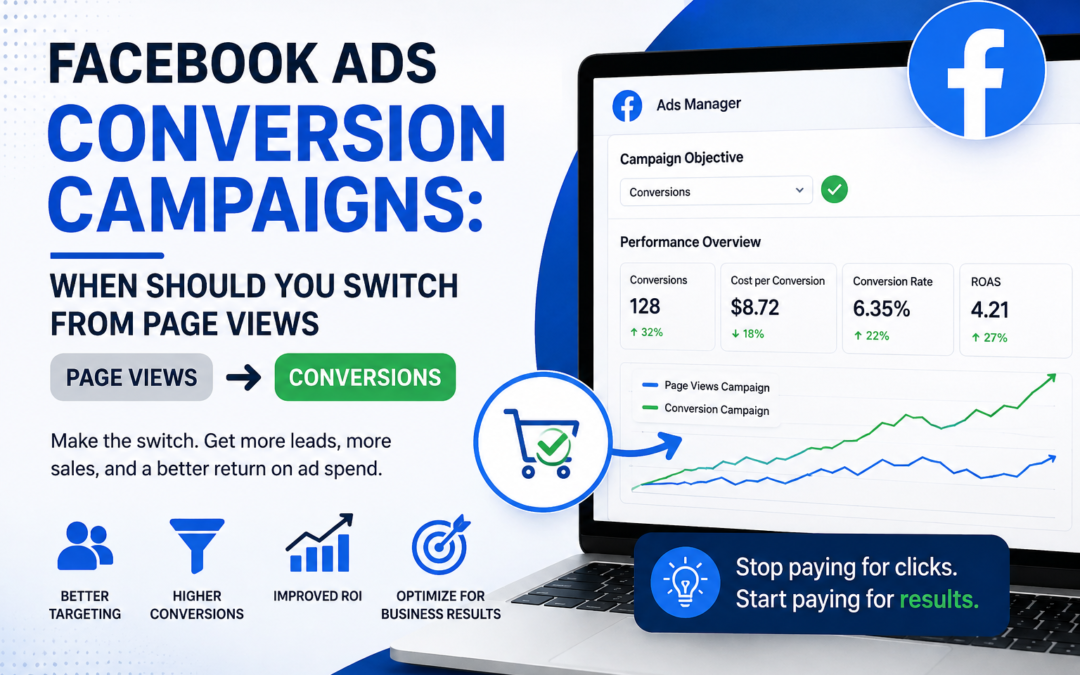
Facebook Ads conversions and landing page views optimize your campaigns for two very different outcomes. Landing page views focus on getting people to your website, while conversion optimization focuses on actions such as leads, appointments, and sales. Choosing the right optimization strategy can significantly affect the quality of the results your advertising generates.
If your goal is simply website traffic, optimizing for visits can make sense. However, if your business needs qualified leads, consultations, appointments, or purchases, Facebook Ads conversions generally align more closely with the result you actually want.
At Impact Digital Marketing’s Facebook Ads management service, we focus advertising strategies on measurable business outcomes rather than simply generating inexpensive clicks and website traffic.
Facebook Ads Conversions vs Landing Page Views: What’s the Difference?
The biggest difference between conversion and traffic optimization is the behavior you are asking Meta’s advertising system to prioritize.
With landing page views, Meta attempts to deliver your advertisements to users who are more likely to click your ad and successfully load your website. Conversion optimization instead uses your selected conversion event to help guide campaign delivery.
Depending on your business and campaign, that conversion event might include:
- Submitting a lead form
- Requesting a consultation
- Booking an appointment
- Registering for a service
- Completing a purchase
This distinction matters because someone who frequently clicks advertisements is not necessarily someone who frequently becomes a customer.
Meta provides additional information about its campaign objectives and advertising options through its official Meta advertising resources.
Should You Start With Traffic or Conversion Optimization?
If your primary objective is generating leads or sales and your conversion tracking works correctly, optimizing for a meaningful conversion event is generally more closely aligned with your business goal.
However, traffic optimization can still be useful when:
- You are testing a brand-new landing page.
- You want to verify that visitors are reaching your website correctly.
- Your account has very little conversion data.
- Your immediate campaign objective really is website traffic.
- You are testing audiences or creative before evaluating deeper actions.
When comparing landing page views with conversion optimization, remember that website traffic alone does not indicate whether visitors are becoming qualified prospects.
The mistake is assuming that inexpensive website traffic automatically leads to inexpensive customer acquisition. Traffic and conversions represent different user behaviors, so they should be evaluated differently.
Why Website Traffic Can Produce Few Leads
A traffic campaign can perform exactly as instructed while still generating very few customers.
If Meta is asked to maximize website visits, the advertising system looks for opportunities to generate those visits. That is different from asking Meta to optimize for completed lead forms, booked consultations, or purchases.
Businesses using landing page views should evaluate whether the additional traffic actually results in forms, calls, appointments, or purchases.
This is why a campaign can generate inexpensive clicks and appear successful inside Ads Manager while producing relatively few qualified prospects.
A campaign generating $0.50 clicks but almost no qualified leads may ultimately be less valuable than one generating more expensive clicks that consistently result in appointments or sales.
Conversion-focused optimization shifts the signal toward the business action you actually want rather than simply attracting visitors.
When Should You Switch to Facebook Ads Conversions?
You should consider moving toward Facebook Ads conversions when your tracking is reliable, your landing page functions properly, and your actual objective is generating leads, appointments, or sales.
You do not necessarily need to wait for an arbitrary number of clicks or website visits before changing your optimization strategy.
Instead, ask:
- Is Meta receiving the conversion event correctly?
- Does the event represent a meaningful business action?
- Is the landing page functioning correctly on desktop and mobile?
- Can visitors easily complete the desired action?
- Are the conversions generating qualified prospects?
- Does the campaign objective match the result your business actually wants?
Once your tracking is reliable, moving beyond landing page views can help align campaign optimization more closely with leads, appointments, or sales.
If these pieces are in place, optimizing around a meaningful business outcome can make more sense than continuing to prioritize website visits alone.
How Much Data Do Facebook Ads Conversions Need?
There is no single number of conversions that guarantees a Meta campaign will suddenly become successful or profitable.
Campaign performance can depend on numerous factors, including:
- Advertising budget
- Audience size and quality
- Creative
- Offer
- Landing page quality
- Selected conversion event
- Tracking accuracy
- Conversion volume
- Competition
Instead of asking only, “How many conversions do I need?” advertisers should determine whether Meta is receiving enough accurate and meaningful signals to identify patterns among people completing the desired action.
The quality of those signals matters as much as the raw number. A smaller number of legitimate consultation requests may provide more business value than a larger number of low-intent actions that rarely result in customers.
What If Your Conversion Volume Is Low?
Small businesses often face a challenge that larger advertisers do not: their most valuable conversion may occur relatively infrequently.
For example, a local dentist, salon, medical practice, contractor, law firm, or other service business may not generate dozens of completed appointments every day.
That does not necessarily mean the business should continue optimizing indefinitely for website visitors.
If the deepest conversion event occurs too infrequently to provide useful optimization data, advertisers can evaluate whether another meaningful event higher in the customer journey provides a stronger signal.
For example, if completed appointment bookings are relatively rare but qualified lead forms occur more frequently, the lead event may provide additional optimization data while remaining closely connected to the ultimate business objective.
The goal is not simply to choose whichever event happens most often. The selected event should still represent genuine progress toward becoming a customer.
Choosing the Right Event for Facebook Ads Conversions
The right conversion event should closely represent the business result you want while providing useful optimization data.
For a local service business, possible events include:
- Completed lead forms
- Consultation requests
- Appointment bookings
- Qualified phone leads
- Registrations
- Purchases
If your real goal is booked appointments, optimizing indefinitely for simple website traffic can create a disconnect between your advertising objective and your actual business objective.
Your tracking and campaign setup should communicate which visitors become valuable prospects whenever possible.
How the Meta Pixel and Conversions API Improve Tracking
Accurate tracking gives Meta information about what happens after someone interacts with an advertisement.
The Meta Pixel can record actions visitors perform on your website, while the Conversions API provides another way for businesses to send marketing data to Meta’s systems.
Meta provides additional technical information about server-side tracking through its official Conversions API resources.
Depending on the implementation, reliable browser and server-side data can provide Meta with additional information about actions generated by advertising.
This can strengthen optimization by helping the advertising system distinguish between a simple website visitor and someone who completes a meaningful business action.
For lead-generation campaigns, accurate tracking is particularly important because the ultimate objective is usually not the click itself. You want to understand which advertising interactions generate qualified leads, appointments, customers, and revenue.
What Should You Check Before Changing Optimization?
Before switching from traffic optimization to a conversion-focused strategy, evaluate the entire customer journey rather than looking at Ads Manager in isolation.
- Conversion tracking: Make sure leads, appointments, purchases, and other important actions are recorded correctly.
- Landing page performance: Confirm that visitors can quickly understand your offer and complete the desired action.
- Mobile experience: Make sure forms, phone buttons, calendars, and other conversion elements work properly on mobile devices.
- Conversion rate: Measure how many visitors actually become leads or customers.
- Lead quality: Determine whether your conversions represent legitimate prospective customers.
- Cost per qualified lead: Measure what you pay for valuable prospects rather than focusing only on cost per click.
- Appointment rate: For service businesses, determine how many leads actually schedule appointments.
- Customer acquisition cost: Calculate how much advertising spend is required to acquire a paying customer.
- Return on ad spend: When reliable revenue attribution is available, compare revenue generated with advertising costs.
Why Lead Quality Matters More Than Cheap Traffic
A campaign with a low cost per click can look impressive inside Ads Manager while generating little revenue.
Likewise, a campaign generating inexpensive leads is not necessarily successful if those leads rarely answer the phone, schedule appointments, or become customers.
This is why businesses should evaluate advertising performance using metrics tied to customer acquisition rather than clicks, impressions, and website traffic alone.
A useful way to think about the customer journey is:
Advertisement → Website Visit → Qualified Lead → Appointment → Customer
Understanding this entire path provides a much clearer picture of whether your advertising is actually contributing to business growth.
How Can AI and CRM Automation Improve Lead Follow-Up?
Generating a conversion is only the beginning.
A successful advertisement can still produce poor business results when leads receive no response, calls go unanswered, or potential customers wait hours for someone to contact them.
AI-powered CRM and communication tools can help businesses respond to website inquiries, manage incoming calls, communicate with leads, and schedule appointments depending on the system and implementation.
This creates a more connected process between advertising, lead generation, follow-up, and customer acquisition.
Fast follow-up can be particularly important for businesses optimizing toward conversions because generating the initial lead does not guarantee that person will ultimately become a customer.
Which Campaign Strategy Is Right for Your Business?
Neither traffic nor conversion optimization is universally better. The right strategy depends on what you want the campaign to accomplish.
If your objective is simply generating website visitors, landing page views may be appropriate.
If your objective is generating qualified leads, consultations, appointments, or purchases, conversion-focused optimization generally aligns more directly with those goals—provided your tracking and conversion setup are reliable.
Ultimately, landing page views are most useful when website traffic itself is the objective or when you are gathering information during early campaign testing.
The important principle is to optimize Meta toward the behavior that creates actual value for your business.
Frequently Asked Questions About Facebook Ads Conversions
Are landing page views bad for Facebook advertising?
No. They can be useful when your objective is website traffic or when you are testing a new landing page, audience, creative, or advertising setup. Problems can occur when businesses optimize for traffic while expecting Meta to prioritize leads or sales.
Should a new Facebook Ads account start with conversions?
If conversion tracking is properly configured and the primary business objective is leads or sales, starting with a meaningful conversion event may make sense. Accounts with very little conversion activity may need to test which meaningful event provides enough useful data for optimization.
Do I need 50 conversions before optimizing for conversions?
No single conversion threshold guarantees campaign success. Conversion volume affects the amount of information available to Meta, but budget, audience, event quality, creative, landing page performance, tracking, and competition can also influence results.
What Is the Best Event for Facebook Ads Conversions?
The best event is generally one that represents meaningful progress toward becoming a customer while occurring frequently enough to provide useful optimization data. Depending on the business, this could be a qualified lead, consultation request, appointment booking, or purchase.
Can the Meta Pixel and Conversions API work together?
Yes. Businesses can use browser-based Pixel data alongside Conversions API data as part of their measurement strategy when the systems are implemented correctly.
Should I optimize for website traffic or leads?
If your primary objective is traffic, website-visit optimization can be appropriate. If your objective is generating qualified prospects and your conversion tracking works correctly, optimizing for a meaningful lead event generally aligns more closely with that business goal.
Final Takeaway: Optimize for Real Business Results
The most important principle is simple: optimize your Facebook advertising around the result your business actually wants.
Traffic optimization can help generate website visits and provide useful information when testing a campaign or landing page. But website traffic alone does not tell you whether your advertising is producing customers.
If your business needs leads, appointments, or sales, build your advertising strategy around accurately measuring those actions and providing Meta with meaningful conversion signals.
Reliable tracking, a strong landing page, relevant creative, the right conversion event, qualified leads, and fast follow-up all contribute to successful Facebook Ads conversions.
Learn more about how Impact Digital Marketing combines paid advertising, SEO, website development, conversion tracking, and lead-generation technology to help businesses generate measurable growth.
When these pieces work together, you can evaluate your advertising based on what matters most: real leads, real customers, and real business results.