Facebook Ads Conversion Campaigns: When Should You Switch From Page Views to Conversions?
Facebook Ads conversion campaigns are designed to help advertisers generate meaningful actions such as leads, appointments, and sales instead of simply driving website traffic. Effective Facebook Ads optimization means telling Meta which business result actually matters. If your account has little or no conversion history, landing page view optimization can temporarily help generate traffic and test your landing page, creative, and audience. However, businesses seeking leads, appointments, or sales should ultimately move toward conversion optimization rather than optimizing indefinitely for traffic.
At Impact Digital Marketing, we manage Facebook and Instagram advertising with a focus on measurable business outcomes. Our approach to Facebook Ads optimization looks beyond clicks and evaluates whether advertising actually generates qualified leads, appointments, sales, and revenue.
What Is the Difference Between Landing Page Views and Facebook Ads Conversion Campaigns?
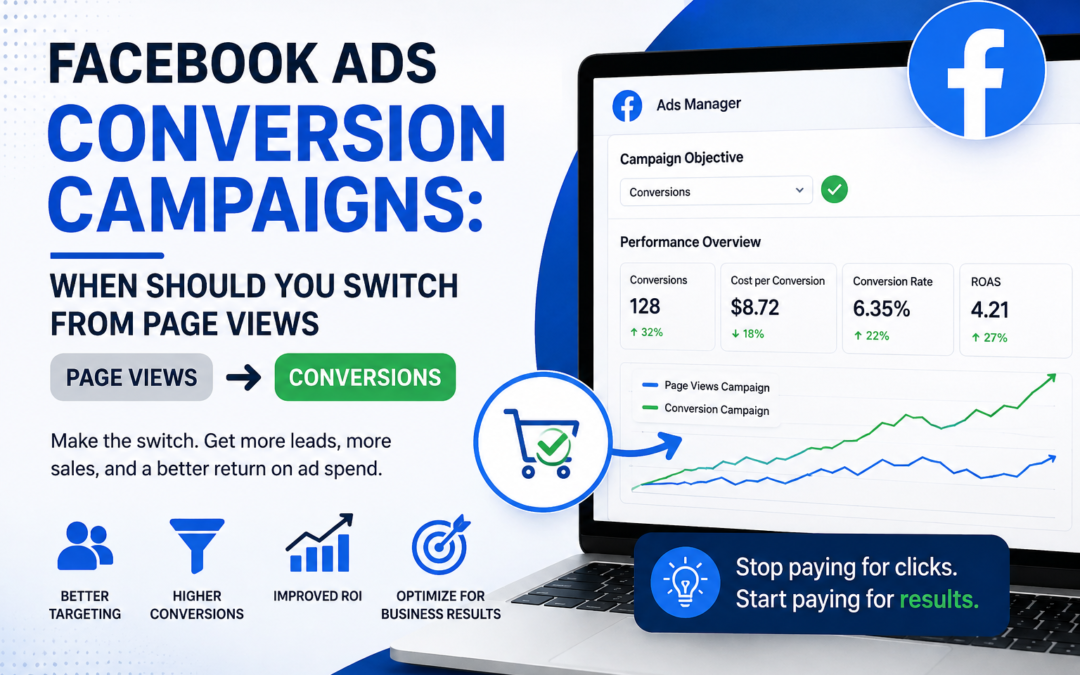
Landing page view optimization tells Meta to look for people who are likely to click your advertisement and successfully load your website. Facebook Ads conversion campaigns, on the other hand, focus campaign delivery on people who may be more likely to complete the action connected to your advertising objective.
That action might include submitting a lead form, requesting a consultation, booking an appointment, registering for a service, or making a purchase. The important difference is the signal you provide to Meta’s advertising system.
Meta provides additional information about campaign objectives and advertising options through its official Meta for Business advertising resources.
Should You Start Facebook Ads With Traffic or Conversions?
If your primary objective is leads or sales and your conversion tracking works correctly, Facebook Ads conversion campaigns are generally the better long-term strategy. Traffic campaigns can still be useful when an account has very little data, when you are testing a new landing page, or when your immediate objective is generating website visits.
The important distinction is that traffic and conversions are not interchangeable. Someone who frequently clicks advertisements is not necessarily someone who frequently submits forms, schedules appointments, or purchases products.
This is why a campaign can generate inexpensive clicks and appear successful while producing very few actual customers. Proper Facebook Ads optimization focuses on the metrics connected to your real business objective.
How Many Conversions Does Meta Need for Facebook Ads Optimization?
There is no single number of conversions that guarantees a campaign will suddenly become successful. Campaign performance depends on numerous factors, including your budget, conversion volume, audience, creative, offer, landing page, tracking quality, and selected optimization event.
A business should not assume that it must reach one specific conversion threshold before it can run Facebook Ads conversion campaigns. The better question is whether Meta receives enough accurate information to identify patterns among the people completing your desired action.
For smaller businesses, the deepest possible conversion event may sometimes occur too infrequently to provide useful optimization data. In that situation, advertisers may test another meaningful event that occurs more frequently while continuing to improve tracking and conversion volume.
What Should You Evaluate Before Switching to Conversion Optimization?
Before changing your campaign strategy, make sure Meta receives reliable information about what visitors do after interacting with your advertisements.
- Conversion tracking: Confirm that important actions such as leads, appointments, and purchases are recorded correctly.
- Conversion volume: Determine whether your campaign generates enough meaningful events to evaluate performance.
- Cost per lead or acquisition: Measure what you actually pay for business results rather than focusing only on cost per click.
- Landing page conversion rate: Determine whether visitors take action after reaching your website.
- Lead quality: Inexpensive leads provide little value if they rarely become customers.
- Return on ad spend: When revenue tracking is available, compare advertising revenue with campaign costs.
Why Can a Page View Campaign Generate Traffic but Few Customers?
The answer comes down to the signal you provide to Meta’s advertising system.
If you ask Meta to maximize landing page views, its system attempts to find people likely to visit websites. With Facebook Ads conversion campaigns, you instead optimize around a business action such as a lead, appointment, registration, or purchase.
Therefore, optimizing for inexpensive traffic can produce exactly what you requested—more visitors—without necessarily producing more customers.
Facebook Ads optimization works best when your campaign objective closely matches the business result you actually want.
What Conversion Event Should You Optimize For?
Choose an event that closely represents your real business objective while generating enough useful data for campaign optimization.
For a local service business, valuable events could include:
- Completed lead forms
- Appointment bookings
- Qualified phone leads
- Consultation requests
- Completed purchases
If your ultimate objective is booked appointments, optimizing indefinitely for page views may focus your campaign on the wrong behavior. Your advertising and tracking should communicate which visitors become valuable prospects whenever possible.
How Do the Meta Pixel and Conversions API Help Facebook Ads Optimization?
The Meta Pixel can record actions visitors perform on your website. Meta’s Conversions API provides another way for businesses to send marketing data to Meta’s systems.
Using reliable conversion data can strengthen Facebook Ads optimization by giving the advertising system better information about which interactions produce meaningful business outcomes.
Meta provides detailed information about this technology through its official Conversions API resources.
For businesses focused on lead generation, accurate tracking becomes especially important because the goal should not simply be generating clicks. The goal is understanding which advertising interactions eventually produce leads, appointments, customers, and revenue.
Should Small Businesses Wait for a Specific Number of Conversions?
No. A small business should not automatically remain on landing page view optimization simply because its conversion volume is relatively low.
A local dentist, salon, contractor, law firm, medical practice, or other service business operating on a modest advertising budget may generate fewer conversion events than a large e-commerce advertiser.
That does not mean the business should optimize forever for website visitors.
Instead, evaluate the amount and quality of conversion data available and choose a meaningful event that provides Meta with a useful optimization signal.
For example, if appointment bookings occur too infrequently, a qualified lead submission may temporarily provide more data while still being substantially closer to the actual business objective than a simple page view.
What Metrics Matter Most in Facebook Ads Conversion Campaigns?
When evaluating Facebook Ads conversion campaigns, avoid judging performance primarily by clicks, impressions, or page views. Focus instead on metrics connected to actual business outcomes.
- Cost per conversion: How much are you spending for each desired action?
- Conversion rate: What percentage of visitors become leads or customers?
- Cost per qualified lead: How much does it cost to generate a lead your business actually wants?
- Appointment rate: How many leads become scheduled appointments?
- Customer acquisition cost: How much advertising spend is required to acquire a customer?
- Return on ad spend: How much measurable revenue does the campaign generate relative to advertising spend?
Impact Digital Marketing also provides digital marketing and lead generation services that combine paid advertising with SEO, website development, conversion tracking, and other strategies designed to help businesses generate measurable growth.
How Can AI CRM Automation Improve Facebook Lead Follow-Up?
Generating a conversion is only the beginning. A business can run effective Facebook Ads conversion campaigns and still lose potential customers when calls go unanswered or leads wait too long for a response.
Fast follow-up can help businesses move prospects from initial interest toward an appointment or sale. AI-powered CRM tools can assist with website inquiries, incoming calls, lead communication, and appointment scheduling depending on the business and implementation.
This creates a more connected process between advertising, lead generation, follow-up, and conversion.
When Should You Switch to Facebook Ads Conversion Campaigns?
Consider Facebook Ads conversion campaigns when your conversion tracking is reliable, your landing page functions properly, and your actual objective is generating leads, appointments, or sales rather than simply attracting visitors.
Do not make the decision based solely on reaching an arbitrary number of clicks or page views.
Instead, ask:
- Is Meta receiving the conversion event correctly?
- Is the landing page converting visitors?
- Are we generating enough conversion data to evaluate performance?
- Are the conversions producing qualified prospects?
- Does the campaign objective match our actual business goal?
If these pieces are in place, Facebook Ads optimization around the business outcome you actually value may be more meaningful than continuing to optimize primarily for traffic.
Frequently Asked Questions About Facebook Ads Conversion Campaigns
Do I need a specific number of conversions before running a Facebook conversion campaign?
No single conversion threshold guarantees campaign success. The amount of data needed can depend on your campaign, budget, audience, conversion event, and other factors. Focus on providing Meta with accurate and meaningful conversion signals.
Are landing page view campaigns bad?
No. Landing page view optimization can be useful when your objective is website traffic or when testing a new campaign and landing page. Problems can occur when businesses optimize for traffic while expecting the advertising system to prioritize leads or sales.
Should a new Facebook Ads account start with conversions?
If conversion tracking is correctly configured and your primary objective is leads or sales, conversion-focused optimization may make sense from the beginning. Accounts with extremely limited conversion volume may need to test different meaningful optimization events as they accumulate data.
What is the best Facebook Ads optimization event for lead generation?
The best Facebook Ads optimization event is generally a meaningful business action that represents genuine progress toward becoming a customer while occurring frequently enough to provide useful campaign data. Depending on the business, this could be a qualified lead, consultation request, appointment booking, or purchase.
Can the Meta Pixel and Conversions API work together?
Yes. Businesses can use browser-based Pixel data alongside Conversions API data as part of their measurement strategy. Proper implementation can provide additional signals for measuring actions that occur after someone interacts with an advertisement.
Final Takeaway: Optimize Facebook Ads for the Result You Actually Want
The most important principle is simple: optimize your Facebook Ads around the business outcome you actually want.
If you want website traffic, landing page view optimization can make sense. If you want qualified leads, appointments, or purchases, your long-term strategy should focus on accurately tracking and optimizing those actions.
Effective Facebook Ads conversion campaigns depend on more than reaching an arbitrary conversion threshold. Reliable tracking, useful conversion data, strong landing pages, relevant advertising, lead quality, and fast follow-up all contribute to performance.
Consistent Facebook Ads optimization then helps you evaluate those signals and make better decisions about objectives, conversion events, creative, audiences, landing pages, and advertising budgets.
Impact Digital Marketing helps businesses connect digital advertising, conversion tracking, lead management, and AI-powered automation so marketing does not stop when someone clicks an ad.