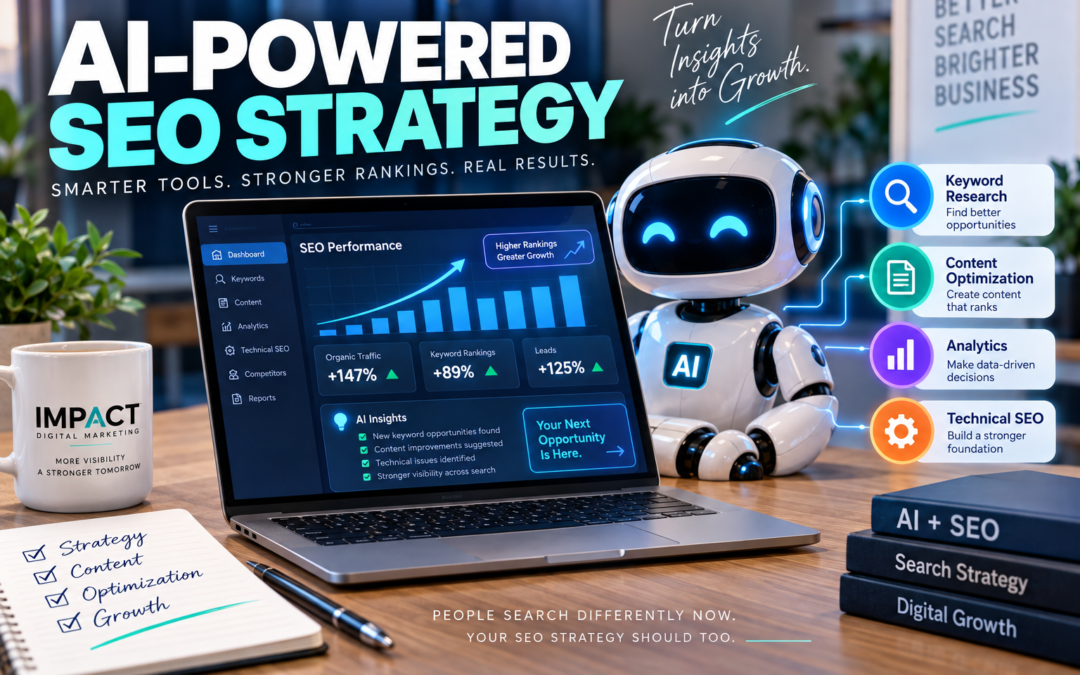
An AI-powered SEO strategy uses artificial intelligence to analyze search data, identify opportunities, optimize content, automate repetitive tasks, and help marketers make faster, data-driven decisions. Instead of replacing traditional SEO or human expertise, AI can make many parts of search engine optimization more efficient.
Modern AI-driven SEO tools can assist with keyword research, content optimization, competitive analysis, technical audits, forecasting, and performance monitoring. These capabilities give businesses access to information that would otherwise require hours of manual analysis.
Artificial intelligence is changing how marketers approach SEO, but successful optimization still requires human judgment, useful content, technical fundamentals, and a clear understanding of the customer.
At Impact Digital Marketing, we combine modern technology with practical digital marketing strategies to help businesses improve online visibility, generate leads, and adapt to changes in search.
What Is an AI-Powered SEO Strategy?
An AI-powered SEO strategy incorporates artificial intelligence into different parts of the search optimization process. AI systems can process large amounts of information, recognize patterns, compare data, and identify opportunities more quickly than manual analysis alone.
SEO professionals can use those insights to improve keyword research, content planning, website structure, technical performance, competitive analysis, and reporting.
The goal is not to hand an entire SEO campaign over to artificial intelligence. A stronger approach combines the speed of AI with human experience, strategic thinking, creativity, and quality control.
How Is Artificial Intelligence Changing SEO?
Search engine optimization has evolved significantly. Early SEO often relied heavily on exact-match keywords, backlinks, and relatively simple ranking signals.
Modern search engines have become much better at interpreting language, context, relationships between topics, and user intent. At the same time, marketers now have access to increasingly sophisticated artificial intelligence systems.
AI can analyze large datasets, identify patterns, organize information, and help professionals determine where improvements may have the greatest impact.
This combination of automation and human decision-making can create a faster and more adaptable optimization process.
Core Benefits of Using AI in SEO
One of the biggest advantages of artificial intelligence is efficiency. Tasks that once required hours of manual analysis can often be completed much faster with the assistance of modern technology.
Businesses can use AI to evaluate large amounts of search and website data, identify patterns, discover potential content opportunities, and organize information for further analysis.
Faster Data Analysis
Artificial intelligence can process large datasets quickly. Marketers can use this capability to identify search trends, compare performance, evaluate keywords, and find potential opportunities.
Better Content Planning
AI can help identify related questions, search themes, content gaps, and topics that deserve additional coverage.
Marketers can then use those insights to build content around genuine customer needs rather than simply publishing articles without a clear strategy.
More Efficient SEO Workflows
Repetitive activities such as reporting, data organization, keyword grouping, and certain types of website analysis can consume significant time.
Automation can reduce that workload and give SEO professionals more time for strategy, creative decisions, and client communication.
How AI-Driven SEO Tools Support Modern Optimization
AI-driven SEO tools can assist marketers throughout an SEO campaign. Their capabilities vary significantly, but common uses include keyword research, content analysis, competitor research, technical auditing, and reporting.
These systems can quickly organize large amounts of information and highlight areas that deserve human review.
Keyword Research
AI tools can help organize keywords by subject, intent, competition, or relevance. This can make large keyword lists easier to analyze.
However, search volume alone should not determine which keywords a business targets. Commercial relevance, user intent, geographic relevance, and the services a company actually provides remain important considerations.
Content Optimization
Artificial intelligence can evaluate page structure, headings, topics, related terms, and other content elements.
These recommendations can provide useful guidance, but marketers should avoid blindly following every automated suggestion. Content still needs to sound natural and genuinely help the reader.
Competitive Analysis
Businesses can use AI-driven SEO tools to organize competitor data and identify potential gaps in their own strategies.
For example, an analysis might reveal topics competitors cover, keywords associated with competing pages, or areas where a business could provide more useful information.
Using AI SEO Analytics to Find Better Opportunities
Analytics plays an important role in an AI-powered SEO strategy. Instead of reviewing every metric manually, artificial intelligence can help organize large datasets and identify patterns that deserve attention.
Businesses can examine traffic, landing-page performance, search queries, conversions, engagement, and other relevant metrics.
The most useful analysis connects SEO activity with actual business results rather than focusing only on rankings.
Look Beyond Website Traffic
More traffic does not automatically mean better marketing.
A business ultimately needs visitors who take meaningful actions, such as calling, submitting a contact form, scheduling an appointment, requesting a consultation, or purchasing a product.
SEO analytics should therefore connect visibility with conversions whenever possible.
Automating Repetitive SEO Tasks With AI
Automation can save substantial time when marketers use it appropriately.
Common tasks that AI and automation can assist with include:
- Keyword organization
- Content research
- SEO reporting
- Website monitoring
- Technical issue identification
- Competitor data organization
- Content gap analysis
- Performance trend analysis
The key is determining which activities benefit from automation and which require professional judgment.
Automation works particularly well for repetitive data-heavy tasks. Strategy, brand positioning, creative decisions, and final quality control still benefit greatly from human oversight.
AI for Content Creation and Optimization
Artificial intelligence can help marketers research, outline, organize, edit, and optimize content. It can also identify questions and related subjects that a page may need to address.
However, publishing large amounts of generic AI-generated material without professional review can produce repetitive or inaccurate content.
Strong content should reflect the company’s actual services, expertise, customers, geographic market, and experience.
Combine AI With First-Hand Expertise
Businesses can strengthen content by including information that comes directly from real experience.
This may include:
- Actual customer questions
- Real project examples
- Original photographs
- Case studies
- Before-and-after examples
- Professional observations
- Common problems encountered during real projects
AI can help organize and present this information, while the business provides the expertise that makes the content unique.
Improving On-Page SEO With Artificial Intelligence
On-page SEO involves optimizing individual webpages so search engines and users can clearly understand their purpose.
AI-driven SEO tools can assist with analyzing elements such as:
- Page titles
- Meta descriptions
- Heading structure
- Keyword usage
- Related topics
- Internal links
- Content organization
- Search intent
Automated recommendations can help identify weaknesses, but the final page should prioritize clarity and usefulness rather than trying to satisfy every numerical SEO score.
Using AI for Technical SEO
Technical SEO focuses on whether search engines can efficiently crawl, understand, and index a website.
AI-assisted auditing tools can help identify potential issues involving broken links, redirects, metadata, duplicate pages, crawlability, site architecture, and website performance.
They can also organize technical information so developers and marketers can prioritize problems more efficiently.
Website Speed Still Matters
A technically strong website should also provide a good experience for visitors.
Large images, unnecessary scripts, poor hosting, excessive plugins, and inefficient page construction can slow a website down.
Businesses should regularly evaluate mobile usability, loading performance, image optimization, caching, and other technical factors.
Using AI for Link and Authority Analysis
Backlinks remain an important part of search engine optimization. Artificial intelligence can help organize backlink data, evaluate patterns, compare competitor profiles, and identify potential opportunities.
However, automation should not turn link building into a numbers game.
Relevant links from reputable websites generally provide more strategic value than large quantities of unrelated or low-quality links.
AI for Local SEO and Voice Search
Local businesses need to connect their services with the geographic areas they serve.
AI can assist marketers in analyzing local search behavior, customer questions, reviews, and conversational queries.
Voice search also encourages people to use complete questions rather than short keyword phrases.
For example, someone might type:
“dentist Tampa”
During a conversational or voice search, that person might instead ask:
“Where can I find a dentist near me that offers emergency appointments?”
Understanding these differences can help businesses create content that addresses more specific customer needs.
Competitive Analysis and SEO Forecasting With AI
An AI-powered SEO strategy can also incorporate competitive research and trend analysis.
AI systems can help organize information about competing websites, keywords, content, backlinks, and search visibility.
This information can help marketers identify gaps and opportunities, but competitive analysis should not simply encourage businesses to copy competitors.
The goal is to understand the market and determine where your business can provide stronger information, better service explanations, or a more useful customer experience.
Integrating AI SEO With Digital Marketing
SEO rarely operates in isolation. Search optimization can work alongside paid advertising, social media, email marketing, website development, content marketing, call tracking, and lead management.
Artificial intelligence can help organize data across these channels and provide marketers with a broader picture of customer behavior.
For example, search data may reveal questions that can become blog topics, advertising messages, social posts, FAQs, or email content.
Connecting these channels can create a more consistent marketing strategy.
Limitations of AI-Driven SEO Tools
AI-driven SEO tools can improve efficiency, but they also have limitations.
Artificial intelligence can produce incorrect information, misinterpret context, recommend unnecessary changes, or prioritize metrics that do not align with a company’s actual business goals.
Businesses also need to consider privacy, data security, software costs, and the learning curve associated with new technology.
Human review remains important whenever AI influences customer-facing content or major marketing decisions.
Why Human SEO Expertise Still Matters
Artificial intelligence can process information quickly, but effective marketing requires more than data processing.
Professionals still need to understand the client’s business, customers, competition, brand, services, geographic market, and revenue goals.
Human expertise also becomes important when determining whether an automated recommendation actually makes sense.
The strongest approach combines AI efficiency with professional judgment.
Future Trends in AI and Search Optimization
Artificial intelligence will likely continue influencing how businesses research keywords, analyze websites, create content, evaluate competitors, and understand search behavior.
Search itself is also becoming more conversational and increasingly capable of providing direct answers.
Businesses should therefore focus on creating accurate, useful, well-organized information rather than chasing every new technology trend.
A flexible AI-powered SEO strategy allows companies to adopt useful technology while maintaining proven SEO fundamentals.
How to Build an AI-Powered SEO Strategy
Building an effective AI-powered SEO strategy starts with identifying where artificial intelligence can improve your existing workflow.
A practical process includes:
- Audit