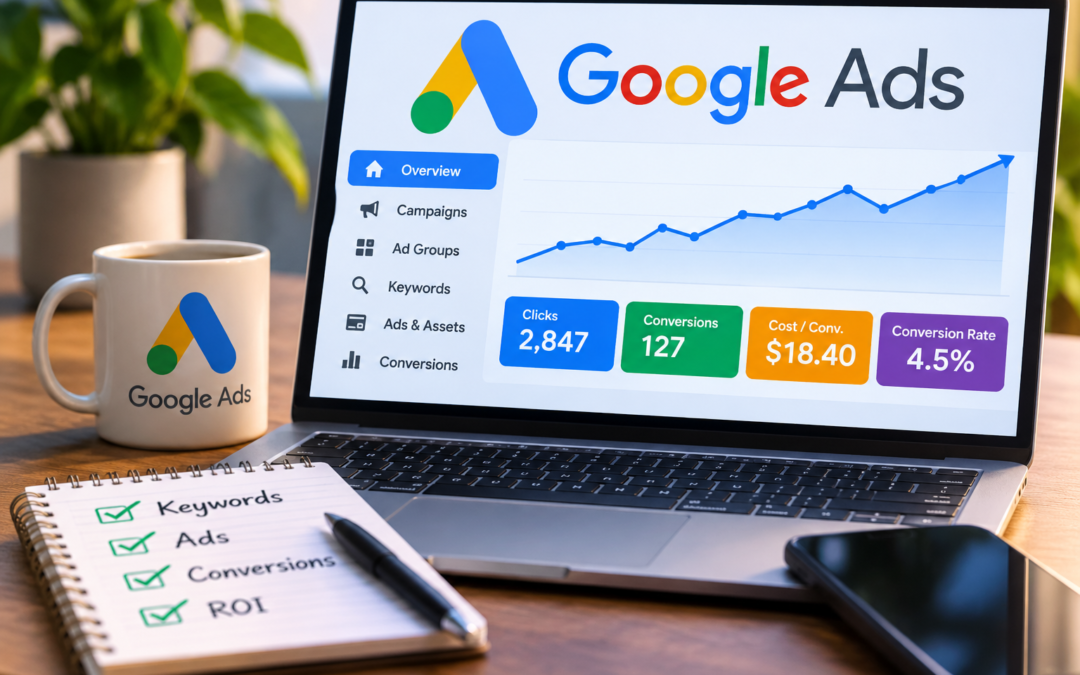
Whether you operate a dental practice, hair salon, home service company, or professional service business, Google Ads can help increase your online visibility. Furthermore, a properly managed pay-per-click advertising campaign can generate qualified website traffic, phone calls, appointment requests, and customer inquiries.
At Impact Digital Marketing, we help small businesses throughout Tampa, Lutz, Pasco County, and the greater Tampa Bay area develop targeted Google Ads and PPC advertising strategies. Additionally, our Conversio AI CRM helps businesses manage incoming leads, automate follow-ups, and track customer interactions.
Quick Answer: Google Ads management for small businesses involves creating, monitoring, and optimizing paid advertising campaigns to attract potential customers through Google Search and other Google advertising channels. Effective PPC management combines keyword research, geographic targeting, conversion tracking, landing page optimization, and lead follow-up systems. As a result, businesses can make more informed advertising decisions and work toward a better return on investment.
What Is Google Ads Management for Small Businesses?
Google Ads is an online advertising platform that allows businesses to promote their products and services across Google’s advertising network. For example, Search ads can appear when someone searches for a local dentist, roofing contractor, hair salon, or marketing agency.
With pay-per-click advertising, commonly called PPC, advertisers generally pay when someone clicks their ad. However, the amount paid per click depends on several factors, including competition, ad relevance, bidding strategy, and auction conditions.
Professional Google Ads management involves more than launching advertisements. Instead, it includes developing an advertising strategy, selecting relevant keywords, controlling costs, measuring conversions, and improving campaign performance over time.
Additionally, ongoing campaign management helps businesses identify which advertisements generate valuable inquiries rather than simply attracting website visitors.
How Does Google Ads Help Small Businesses Generate Leads?
One of the biggest advantages of Google Search advertising is the ability to reach people who are already expressing interest in a product or service. Unlike many traditional advertising methods, Google Search campaigns can target searches that indicate a potential customer is ready to take action.
Reach Customers Searching for Your Services
For example, someone searching for “emergency dentist Tampa” may have an immediate need for dental services. Similarly, a homeowner searching for “roof repair near me” may be actively comparing local contractors.
Therefore, targeting relevant search terms can help businesses reach potential customers with stronger purchasing intent.
Target Specific Cities and Service Areas
Google Ads allows advertisers to select geographic targeting settings. Consequently, a local business can concentrate its advertising on the communities it serves rather than attempting to reach customers nationwide.
For instance, a Tampa business may focus on Carrollwood, Lutz, Wesley Chapel, Brandon, or surrounding Tampa Bay communities. Additionally, location settings can be adjusted based on campaign objectives and performance.
Generate Phone Calls, Forms, and Appointments
Google Ads campaigns can be designed around different business objectives. For example, a dental practice may prioritize appointment requests, while a home service company may focus on phone calls.
Furthermore, conversion tracking can measure valuable actions such as completed contact forms, qualified calls, and appointment bookings. As a result, advertisers can evaluate campaign performance beyond clicks and impressions.
Google Ads vs. SEO: Which Is Better for Small Businesses?
Both Google Ads and search engine optimization can attract potential customers. However, they operate differently and often work best as complementary marketing strategies.
Google Ads for Paid Search Visibility
Google Ads can begin generating visibility after campaigns are approved and start serving. Nevertheless, visibility depends on budget, targeting, competition, and campaign eligibility.
Additionally, paid advertising provides control over campaign budgets, geographic targeting, and promotional messaging.
SEO for Long-Term Organic Visibility
Search engine optimization focuses on improving a website’s visibility in unpaid search results. Unlike PPC advertising, SEO does not charge businesses for each organic search click.
However, achieving strong organic rankings generally requires consistent website optimization, useful content, technical improvements, and time.
Why Combining Google Ads and SEO Makes Sense
For many small businesses, combining both approaches creates a more balanced marketing strategy. For example, Google Ads can target competitive commercial searches while SEO builds long-term organic visibility.
Furthermore, insights from paid search campaigns can help identify keywords and customer questions worth addressing through website content.
Ultimately, the right combination depends on your business goals, competition, marketing budget, and desired timeline.
7 Essential Elements of Successful Google Ads Campaigns
1. High-Intent Keyword Research
Keyword research is the foundation of an effective Google Ads Search campaign. First, businesses must identify the terms potential customers use when searching for their services.
For example, a dental practice may target “dental implants Tampa,” “dentist near me,” or “emergency dental appointment.” Meanwhile, a hair salon may focus on “hair extensions Tampa” or “hair color specialist Tampa.”
Additionally, selecting keywords based on commercial intent can help advertisers prioritize searches more likely to produce inquiries.
2. Negative Keyword Management
Negative keywords help prevent ads from appearing for certain irrelevant searches. For instance, a business selling professional services may want to exclude searches related to free training, employment, or do-it-yourself instructions.
However, negative keywords should be selected carefully to avoid blocking relevant potential customers. Therefore, regularly reviewing search terms is an important part of PPC campaign management.
3. Geographic Targeting
Local businesses should focus their advertising on areas they can realistically serve. For example, a company serving Tampa and Lutz may not want to spend its advertising budget attracting customers from distant cities.
Furthermore, advertisers should review location settings to distinguish people physically located in a target area from those merely showing interest in it, when that distinction matters to their campaign.
4. Compelling Google Search Ads
Effective advertisements should clearly communicate the service, customer benefit, and next step. For example, a dental advertisement might highlight available appointments, specific treatments, or a published new-patient offer.
Additionally, relevant headlines, descriptions, and advertising assets can help potential customers understand what makes a business worth considering.
5. High-Converting Landing Pages
Sending paid traffic to a website is only part of the process. Once visitors arrive, they need a clear reason to contact the business.
Therefore, landing pages should include relevant service information, prominent contact options, mobile-friendly layouts, and straightforward calls to action.
Furthermore, matching landing page content to the advertisement helps create a consistent customer experience.
6. Accurate Conversion Tracking
Without reliable conversion tracking, businesses may know how many clicks they purchased but not which campaigns generated valuable inquiries.
For example, useful conversion actions may include:
- Contact form submissions
- Phone calls from advertisements
- Phone calls initiated from the website
- Appointment booking requests
- Qualified lead submissions
- Completed purchases or confirmed customer conversions
Additionally, tracking qualified leads and actual customers can provide a clearer picture of advertising performance than counting every interaction equally.
7. Continuous Campaign Optimization
Google Ads campaigns require ongoing evaluation. For instance, advertisers should review search terms, conversion rates, cost per lead, geographic performance, and landing page effectiveness.
As a result, businesses can make adjustments based on performance data rather than assumptions.
Moreover, testing different advertisements and landing pages can reveal opportunities to improve campaign efficiency.
How Much Does Google Ads Cost for a Small Business?
Google Ads costs vary significantly depending on industry, location, competition, keyword selection, and campaign goals. Therefore, there is no universal advertising budget that works for every small business.
For example, a local service business operating in a competitive Tampa market may face different advertising costs than a specialty retailer targeting a narrow audience.
Understanding Cost Per Click
Cost per click, or CPC, represents the average amount an advertiser pays for an ad click. However, a lower CPC does not necessarily mean better results.
For instance, a $3 click that produces no inquiries may be less valuable than a $12 click that results in a profitable customer.
Understanding Cost Per Lead
Cost per lead measures the average advertising expense required to generate a tracked lead.
For example, if a campaign spends $600 and generates 20 leads, the average cost per lead is $30.
However, not every lead becomes a paying customer. Consequently, businesses should also monitor lead quality, appointment bookings, customer acquisition costs, and revenue whenever possible.
Choosing a Realistic PPC Budget
Small businesses can begin with controlled advertising budgets. Nevertheless, the budget must be realistic for the industry’s advertising costs and the number of conversions needed to evaluate performance.
Additionally, new campaigns may require time to gather meaningful data. Therefore, campaign decisions should account for conversion delays, tracking accuracy, and sufficient performance history.
Google Ads Bidding Strategies: Maximize Clicks vs. Maximize Conversions
Choosing the right bidding strategy is an important part of PPC advertising management. However, the best strategy depends on the campaign’s objectives and available conversion data.
Maximize Clicks
Maximize Clicks is designed to generate as many clicks as possible within the applicable budget and bidding settings. Therefore, it may be useful when the primary objective is attracting website traffic.
However, additional clicks do not automatically translate into qualified leads or customers.
Maximize Conversions
Maximize Conversions uses Google’s automated bidding technology to pursue conversions within the campaign’s budget and applicable settings.
Furthermore, accurate conversion tracking is important because the bidding system relies on conversion signals to optimize performance.
Maximize Conversion Value
Maximize Conversion Value focuses on generating conversion value rather than simply maximizing the number of conversions.
For example, a business may assign different values to a basic inquiry, a qualified lead, and a completed sale. Consequently, value-based bidding can help prioritize higher-value outcomes when reliable conversion values are available.
Ultimately, businesses should choose a bidding strategy that matches their objectives and measurement capabilities.
Why Google Ads Clicks Do Not Always Become Customers
One of the most common frustrations small businesses experience is paying for advertising clicks without generating enough new customers.
However, the problem may not be the advertising platform itself. Instead, several weaknesses throughout the customer acquisition process can affect results.
Irrelevant Search Traffic
If advertisements appear for searches unrelated to the business’s services, visitors may leave without contacting the company. Therefore, keyword refinement and negative keyword management are essential.
Poor Landing Page Experience
A confusing website, slow-loading page, or unclear call to action can discourage potential customers. Additionally, mobile visitors may abandon pages that are difficult to navigate.
Missing Conversion Tracking
Without reliable tracking, advertisers cannot accurately identify which campaigns generate meaningful business activity. Consequently, optimization decisions become more difficult.
Slow Lead Follow-Up
Even a qualified lead can lose interest if a business responds too slowly. For example, a potential customer may contact several competing companies before choosing one.
Therefore, having a reliable system for responding to inquiries is an important part of the overall advertising strategy.
Failure to Track Actual Sales
A campaign may generate numerous form submissions without producing profitable customers. As a result, measuring qualified leads and completed sales can reveal problems that basic lead counts overlook.
How Conversio AI CRM Helps Turn Google Ads Leads Into Customers
Generating leads through Google Ads is only the beginning. After someone clicks an advertisement and contacts a business, the next challenge is managing that inquiry and guiding the potential customer toward a booking or sale.
That’s where Conversio, the AI-powered CRM and lead management platform from Impact Digital Marketing, becomes valuable.
Instead of treating paid advertising and customer follow-up as separate processes, Conversio helps connect incoming inquiries with the business’s sales and appointment workflow.
AI Voice Receptionist
Missed phone calls can represent missed business opportunities. Therefore, Conversio includes an AI voice receptionist designed to respond to incoming calls and help manage customer inquiries.
AI Website Chat
Some website visitors prefer messaging rather than calling. Consequently, Conversio’s AI website chat gives potential customers another way to ask questions and begin a conversation.
Two-Way SMS and Email Communication
Following up with leads is essential for businesses that depend on appointments and customer inquiries. Additionally, Conversio supports two-way SMS and email communication to help organize customer conversations.
Online Appointment Booking
For appointment-based businesses, reducing friction in the booking process can improve the customer experience. Therefore, Conversio includes online appointment booking, reminders, and waitlist management.
Lead Source Tracking and ROI Reporting
Understanding where leads originate is important when evaluating marketing performance. For example, Conversio can help organize inquiries associated with Google Ads, Facebook advertising, and website interactions.
Furthermore, its reporting tools are designed to connect marketing activity with lead management and business outcomes.
From Advertising Click to Customer Conversion
Consider a potential customer who clicks a Google advertisement and visits a dental practice’s website. First, the visitor may call, submit a form, or start an online conversation.
Next, Conversio can help manage the inquiry through communication and appointment workflows. Finally, the business can track the lead’s progress toward becoming a customer.
As a result, businesses can focus on more than advertising clicks and work toward building a complete lead generation and customer conversion system.
Google Ads Management for Tampa and Tampa Bay Businesses
Local businesses face different advertising challenges depending on their industry and service area. Therefore, effective Google Ads management should reflect the competitive conditions and customer behavior of each market.
Google Ads for Dental Practices
Dental practices can use paid search advertising to promote services such as dental implants, teeth whitening, Invisalign, and emergency dentistry. Additionally, appointment tracking and phone call measurement can help evaluate which campaigns generate patient inquiries.
Google Ads for Hair Salons
Hair salons can target searches related to haircuts, hair coloring, balayage, extensions, and specialty treatments. Furthermore, geographic targeting can help salons focus on customers within a practical driving distance.
Google Ads for Home Service Businesses
Roofers, plumbers, electricians, HVAC contractors, and other home service providers often depend on local customer inquiries. Consequently, campaigns targeting relevant services and geographic areas can help attract potential customers.
Google Ads for Professional Services
Professional service businesses may benefit from campaigns focused on consultations, appointments, and qualified inquiries. However, advertising strategies should account for industry-specific competition and applicable Google Ads policies.
Impact Digital Marketing provides digital marketing services for businesses in Tampa, Lutz, Pasco County, Carrollwood, Wesley Chapel, and surrounding Tampa Bay communities.
How to Measure Google Ads Return on Investment
Successful PPC advertising should be evaluated using business results, not just impressions and clicks. Therefore, businesses should monitor several important performance indicators.
- Click-through rate (CTR): The percentage of ad impressions that result in clicks.
- Cost per click (CPC): The average advertising cost for each click.
- Conversion rate: The percentage of interactions that result in tracked conversions.
- Cost per lead (CPL): The average advertising expense for each lead.
- Qualified lead rate: The percentage of leads that meet the business’s qualification criteria.
- Customer acquisition cost: The total relevant acquisition expense divided by the number of new customers.
- Return on ad spend (ROAS): Revenue attributed to advertising divided by advertising spend.
For example, a campaign that produces 50 leads may appear successful. However, if only two leads become customers, the business must evaluate whether the revenue justifies the advertising expense.
Conversely, a campaign producing fewer leads may be more profitable if those inquiries result in higher-value customers.
Ultimately, tracking the complete customer journey helps businesses make more informed advertising decisions.
Why Hire a Professional Google Ads Management Agency?
Although business owners can create Google Ads campaigns themselves, effective PPC management requires ongoing attention. Furthermore, managing advertisements involves keyword research, bidding strategies, tracking configuration, landing page improvements, and performance analysis.
A professional Google Ads management agency can help businesses develop a structured approach to paid advertising.
For example, professional management may include:
- Google Ads account and campaign setup
- Keyword research and competitor analysis
- Local geographic targeting
- Search advertising campaign management
- Negative keyword research and optimization
- Conversion tracking configuration
- Landing page optimization
- Lead generation strategy
- Campaign performance monitoring
- CRM integration and lead follow-up planning
Additionally, working with an agency that understands both advertising and lead management can help businesses identify weaknesses beyond the Google Ads account itself.
At Impact Digital Marketing, our approach combines digital advertising, website optimization, and Conversio AI CRM capabilities. As a result, businesses can build a more connected system for attracting, managing, and converting potential customers.
Frequently Asked Questions About Google Ads Management
Is Google Ads worth it for small businesses?
Google Ads can be worthwhile for small businesses when campaigns target relevant customers and generate profitable results. However, success depends on competition, budget, conversion tracking, landing pages, and customer follow-up.
How much should a small business spend on Google Ads?
There is no universal starting budget. Instead, businesses should consider industry-specific click costs, geographic competition, conversion rates, and customer value. Therefore, a realistic budget should support meaningful testing without exceeding financial limits.
How long does Google Ads take to generate leads?
Google Ads can begin delivering traffic after campaigns become eligible to serve. However, generating qualified leads and evaluating performance may require additional time. Furthermore, campaign results depend on targeting, competition, landing pages, and conversion tracking.
What is the difference between PPC and Google Ads?
PPC stands for pay-per-click, an advertising pricing model in which advertisers pay for clicks. Google Ads is an advertising platform that offers PPC campaigns alongside other campaign types and pricing approaches.
Can Google Ads help local businesses in Tampa?
Yes. Google Ads provides geographic targeting options that can help Tampa businesses reach potential customers in selected service areas. Additionally, advertisers can target searches related to their specific services.
What is the best Google Ads bidding strategy for lead generation?
The best bidding strategy depends on campaign objectives and available data. For example, Maximize Conversions focuses on generating tracked conversions, while Maximize Conversion Value focuses on assigned conversion values. Therefore, accurate measurement is essential.
Why am I getting Google Ads clicks but no leads?
Several factors may contribute, including irrelevant keywords, weak landing pages, unclear offers, tracking problems, or intense competition. Consequently, reviewing the entire advertising and lead conversion process is important.
Does Google Ads work better than Facebook Ads?
Neither platform is automatically better. Google Search ads can reach people actively searching for services, while Facebook advertising can reach audiences based on targeting and engagement signals. Therefore, the best choice depends on the business, offer, and marketing objectives.
Can AI improve Google Ads lead generation?
AI-powered bidding and campaign features can help optimize advertising based on available signals. Additionally, AI CRM tools such as Conversio can support lead communication, appointment scheduling, and follow-up workflows after an inquiry occurs.
Does Impact Digital Marketing offer Google Ads management in Tampa?
Yes. Impact Digital Marketing offers Google Ads and PPC management as part of its digital marketing services for Tampa Bay businesses. Furthermore, the agency combines advertising strategy with website optimization and Conversio AI CRM lead management capabilities.