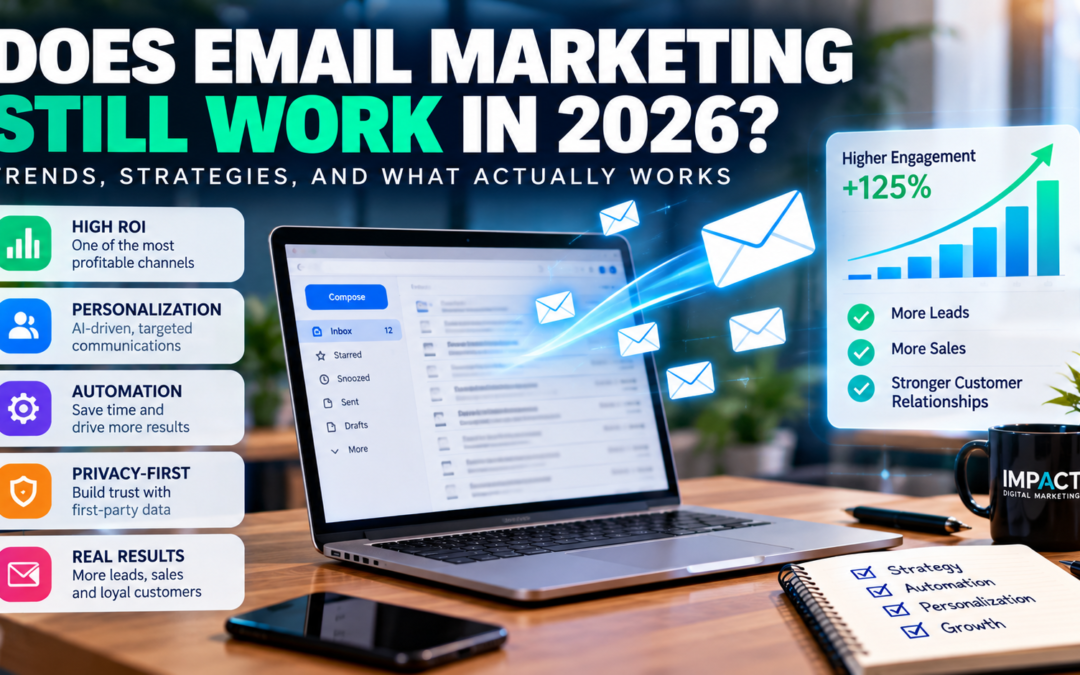
Does email marketing in 2026 still work? Yes—but the strategies that produce results have changed. Generic email blasts, purchased lists, and one-size-fits-all newsletters are giving way to personalization, automation, stronger privacy practices, and carefully segmented campaigns.
Email remains valuable because businesses can communicate directly with people who have chosen to hear from them. However, simply having a large email list does not guarantee results. Businesses need relevant content, proper targeting, strong deliverability, and effective email marketing automation to turn subscribers into customers.
For businesses evaluating their digital marketing strategy, email can complement SEO, social media, paid advertising, SMS, and other channels. More importantly, it gives businesses a direct way to continue communicating with prospects after the initial website visit, form submission, appointment request, or purchase.
Why Email Marketing in 2026 Still Matters
Social media and paid advertising are powerful ways to reach new audiences. However, businesses do not control those platforms. Algorithms change, advertising costs fluctuate, and organic reach can rise or fall.
Email works differently. Once someone voluntarily joins your email list, your business has a direct communication channel with that subscriber. Therefore, email can become particularly valuable for nurturing leads, generating repeat purchases, communicating offers, and maintaining customer relationships.
Additionally, email can support virtually every stage of the customer journey. For example, a prospect who discovers a business through Google may join an email list but not make a purchase immediately. An automated follow-up sequence can continue the conversation until that prospect is ready to take action.
The original article emphasizes this distinction between social media as a platform-controlled channel and email as a more direct communication channel.
Email Marketing vs Social Media
Businesses sometimes treat email and social media as competing marketing channels. In reality, they can serve different purposes.
Social media is particularly useful for:
- Brand awareness
- Reaching new audiences
- Visual content
- Community engagement
- Social proof
- Promotions
Email, on the other hand, can be particularly effective for:
- Lead nurturing
- Customer follow-up
- Appointment reminders
- Special offers
- Repeat purchases
- Customer education
- Re-engagement campaigns
- Personalized communication
Therefore, businesses do not necessarily need to choose between them. Instead, social media can help attract attention while email marketing in 2026 can help businesses continue the relationship.
Personalization Is Changing Email Marketing
One of the biggest changes in modern email marketing is personalization.
In the past, a business might send the exact same newsletter to thousands of subscribers. Today, businesses can segment audiences based on interests, behavior, purchase history, lead status, location, services requested, and other relevant information.
As a result, subscribers can receive messages that better match their interests.
For example, a dental office could send different follow-up emails to someone interested in dental implants than to someone who requested information about teeth whitening.
Likewise, a hair salon could send extension-related information to a potential hair-extension client while sending color-maintenance information to an existing color client.
This approach makes the email more relevant because the message reflects what the customer actually wants.
How AI Is Changing Email Marketing in 2026
Artificial intelligence has become increasingly useful for email marketing. However, AI is not simply a tool for writing subject lines.
Businesses can use AI to help analyze customer behavior, organize audiences, personalize messages, generate content variations, identify engagement patterns, and improve campaign workflows.
For example, AI-assisted systems may help marketers:
- Segment subscribers
- Personalize email content
- Generate subject-line variations
- Recommend products or services
- Analyze customer behavior
- Identify disengaged subscribers
- Optimize campaign timing
- Create different messaging for different audiences
Therefore, AI can make sophisticated personalization more accessible to smaller businesses as well as larger organizations.
Still, businesses should avoid making emails feel robotic. AI can assist with personalization and efficiency, but the message should still sound natural and provide genuine value.
Email Marketing Automation Is Becoming More Important
Email marketing automation allows businesses to automatically send relevant messages based on specific customer actions or stages in the customer journey.
Instead of manually emailing every new lead, for example, a business can create a sequence that begins automatically after someone submits a form.
As a result, businesses can follow up consistently without requiring an employee to manually send every message.
Welcome Email Automation
When someone joins an email list or becomes a new lead, a welcome sequence can introduce the business and explain what happens next.
For example, the sequence might include:
- An immediate welcome message
- Information about the business
- Helpful educational content
- Customer testimonials
- Answers to common questions
- A consultation or appointment invitation
Lead Follow-Up Automation
Not every prospect converts immediately. Therefore, automated follow-up can keep the business visible while the prospect considers their options.
For service businesses, this can be especially valuable after someone requests information but does not schedule an appointment.
Abandoned Cart Emails
E-commerce businesses can use email marketing automation to contact customers who add products to their carts but leave before completing the purchase.
For example, an automated message might remind the shopper about the product, answer common questions, or provide another reason to return.
Re-Engagement Campaigns
Some subscribers eventually stop interacting with emails. Instead of continuing to send messages indefinitely, businesses can create automated re-engagement campaigns.
For instance, the campaign might ask whether the subscriber still wants to receive emails or offer an opportunity to change communication preferences.
Email Marketing and Customer Data
Privacy has become increasingly important in digital marketing. Consequently, businesses need to think carefully about how they collect and use customer information.
First-party data comes directly from interactions between a business and its customers or prospects.
Zero-party data generally refers to information customers intentionally provide about themselves, such as their interests or preferences.
For example, businesses can collect useful information through:
- Preference centers
- Contact forms
- Customer surveys
- Product quizzes
- Appointment forms
- Purchase information
- Service requests
Therefore, businesses can personalize communication based on information customers have actually provided rather than relying entirely on third-party tracking.
Why Email Open Rates Can Be Misleading
Email marketers traditionally relied heavily on open rates. However, privacy technologies have made this metric less dependable as a direct measurement of human engagement.
Apple Mail Privacy Protection, for example, can affect how email opens are recorded. Therefore, an apparent open does not always mean someone actively opened and read the message.
As a result, businesses should evaluate deeper engagement metrics as well.
These can include:
- Clicks
- Replies
- Form submissions
- Appointments
- Purchases
- Website conversions
- Unsubscribes
- Spam complaints
Ultimately, the most important measurement depends on the campaign objective. If the goal is to generate appointments, for example, booked appointments matter considerably more than opens.
Email Deliverability in 2026
A great email campaign cannot generate results if messages never reach the inbox.
Therefore, deliverability remains one of the most important parts of email marketing in 2026.
Email providers increasingly evaluate sender behavior, authentication, complaints, engagement, and other signals when deciding where messages should appear.
Consequently, businesses need to protect their sender reputation.
Authenticate Your Email Domain
Businesses should properly configure relevant email authentication technologies, including SPF, DKIM, and DMARC.
These technologies help receiving email systems verify that messages claiming to come from a domain are authorized.
Keep Your Email List Clean
Sending repeatedly to invalid or chronically disengaged addresses can hurt email performance. Therefore, businesses should monitor their lists and establish appropriate procedures for inactive subscribers.
Make Unsubscribing Easy
Businesses should not make subscribers search for a way to leave the list.
Instead, provide a clear unsubscribe process. Making the process difficult can frustrate recipients and may increase spam complaints.
Avoid Sudden Volume Spikes
Businesses using new sending infrastructure should be cautious about suddenly sending extremely large volumes of email.
Instead, sending practices should support a healthy reputation and consistent deliverability.
Mobile-Friendly Email Is Essential
Customers frequently interact with email on smartphones and other mobile devices. Therefore, every campaign should be easy to read and use on smaller screens.
Mobile-friendly email design should include:
- Readable text
- Clear calls to action
- Mobile-friendly buttons
- Short paragraphs
- Simple layouts
- Optimized images
- Fast-loading content
Additionally, marketers should test emails before sending them to ensure important information displays correctly across common devices and email applications.
Accessible Email Design
Accessibility is another important consideration for modern email campaigns.
For example, businesses can improve accessibility by:
- Using descriptive alternative text for important images
- Maintaining sufficient text and background contrast
- Using readable font sizes
- Creating descriptive links and buttons
- Maintaining a logical content structure
- Avoiding unnecessary visual clutter
As a result, emails can become easier for more people to understand and interact with.
Interactive Email Marketing
Interactive content can also help businesses create more engaging email experiences. However, marketers should consider compatibility because advanced interactive features may not work consistently across every email client.
Depending on the platform and audience, interactive elements might include:
- Surveys
- Polls
- Quizzes
- Product selections
- Interactive product displays
- Appointment links
- Personalized recommendations
Nevertheless, the primary goal should remain simplicity. Interactive features should make it easier for subscribers to take action rather than making the email unnecessarily complicated.
Best Email Marketing Automation for Small Businesses
Small businesses do not necessarily need dozens of complicated automations.
Instead, a few well-designed email marketing automation workflows can address important stages of the customer journey.
For many businesses, useful automations include:
- Welcome sequence: Introduce the company and explain its services.
- New lead follow-up: Continue communicating after a form submission or inquiry.
- Appointment follow-up: Provide relevant information surrounding an appointment.
- Abandoned cart sequence: Encourage shoppers to return and complete a purchase.
- Post-purchase follow-up: Thank customers and provide relevant next steps.
- Re-engagement sequence: Attempt to reconnect with inactive subscribers.
Most importantly, each automation should have a specific purpose rather than sending emails simply because automation makes it possible.
How Email Works With SMS Marketing
Email and SMS can also complement each other.
Email is useful when a business needs space to explain something, provide educational content, show products, or tell a longer story.
SMS, by comparison, can work well for concise and time-sensitive communication when the recipient has provided the appropriate consent.
Therefore, businesses can build communication strategies that use each channel for the situations where it makes the most sense.
For example, a business might send detailed information through email and use an appropriately consented text message for an appointment reminder.
How Email Marketing Supports Lead Generation
One of email’s greatest strengths is what happens after a lead arrives.
Consider someone who finds a business through Google Ads, Facebook Ads, SEO, social media, or a Google Business Profile.
The visitor may submit a form without immediately becoming a customer.
Without follow-up, that lead can disappear.
However, email marketing automation can continue the conversation automatically. The business can provide helpful information, answer common questions, demonstrate expertise, share testimonials, and encourage the prospect to schedule an appointment or make a purchase.
Therefore, email can serve as an important bridge between lead generation and conversion.
How to Improve Email Marketing Results
Businesses looking to improve email marketing in 2026 should focus on relevance rather than simply increasing sending volume.
1. Prioritize Quality Over Quantity
First, send emails when you have something useful to communicate. Sending more frequently does not automatically produce better results.
2. Segment Your Audience
Next, avoid treating every subscriber identically. Instead, create groups based on meaningful customer characteristics and behavior.
3. Use Automation Strategically
Additionally, build automations around real customer actions and business objectives.
4. Optimize for Mobile
Because subscribers frequently read email on mobile devices, keep messages easy to scan and calls to action easy to select.
5. Test Your Campaigns
Finally, test different elements of your emails rather than assuming one approach will always perform best.
For example, businesses can test:
- Subject lines
- Email copy
- Calls to action
- Offers
- Images
- Send times
- Audience segments
- Landing pages
Then, use actual campaign results to guide future decisions.
Frequently Asked Questions About Email Marketing in 2026
Does email marketing still work in 2026?
Yes. Email marketing in 2026 can still help businesses nurture leads, communicate with customers, generate repeat business, and support conversions. However, results depend on audience quality, relevance, deliverability, consent, targeting, and the overall campaign strategy.
Is email marketing better than social media?
They serve different purposes. Social media can help businesses reach and engage audiences, while email provides a direct communication channel with subscribers. Therefore, many businesses benefit from using both.
Is email marketing automation worth it?
Yes, when it serves a clear business purpose. Email marketing automation can improve consistency by automatically following up with leads and customers based on specific actions or stages in their journey.
How often should a business send marketing emails?
There is no universal frequency that works for every business. Instead, frequency should depend on the audience, type of business, customer expectations, campaign purpose, and engagement data.
What email metrics matter most?
The most useful metrics depend on the campaign objective. For example, businesses may track clicks, replies, appointments, purchases, leads, conversions, unsubscribes, and spam complaints rather than relying solely on open rates.
Can AI improve email marketing?
Yes. AI can assist with segmentation, content creation, personalization, analysis, recommendations, and campaign optimization. However, businesses should still ensure messages remain accurate, useful, and appropriate for their customers.
Email Marketing in 2026: The Bottom Line
Email marketing in 2026 is not dead. Instead, it has become more sophisticated.
Consumers expect greater relevance, stronger privacy protections, useful information, and more personalized communication. Meanwhile, businesses have access to increasingly powerful automation and AI technologies.
Therefore, successful email marketing is becoming less about sending the largest possible number of emails and more about sending the right message to the right person at the right stage of the customer journey.
Email marketing automation can make that process significantly more efficient by connecting lead generation, customer follow-up, appointment communication, nurturing, and re-engagement into a coordinated system.
Impact Digital Marketing helps businesses combine email marketing with SEO, Google Ads, Facebook Ads, SMS, website development, CRM technology, AI communication tools, lead tracking, and marketing automation.
To learn more, visit Impact Digital Marketing and discover how an integrated digital marketing strategy can help turn more leads into customers.