
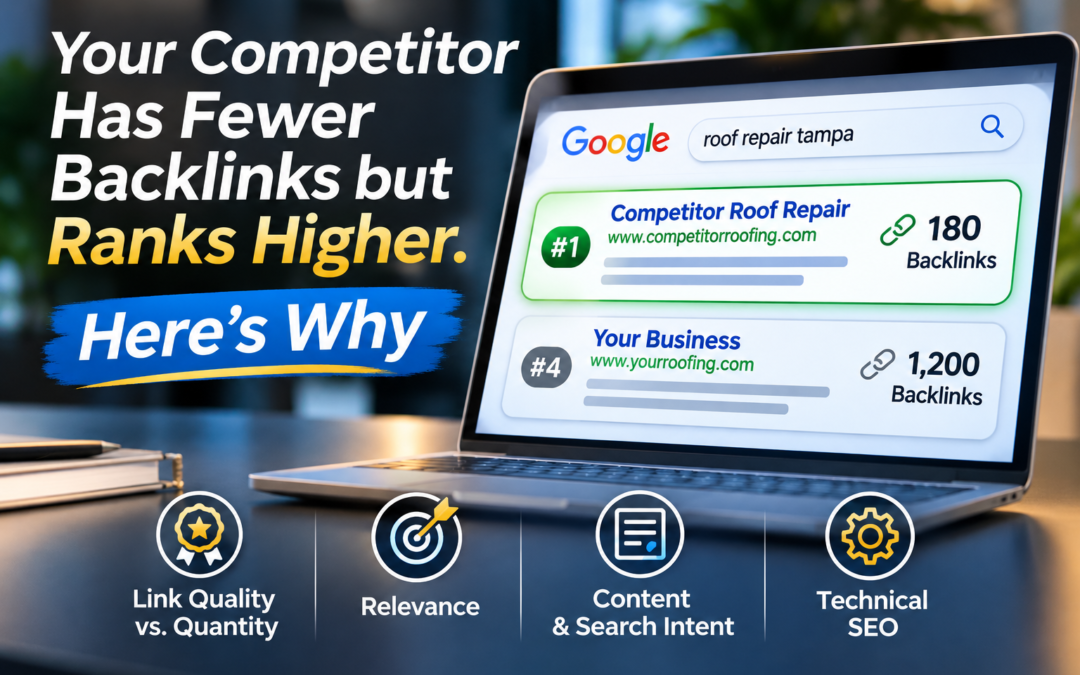
Imagine spending months building backlinks to your website. After earning hundreds of links, investing in SEO tools, and watching your backlink count increase, you expect better Google rankings. Unfortunately, a competitor with significantly fewer backlinks continues to outrank you.
Frustrating? Absolutely. However, there’s a reason this happens, and it reveals one of the biggest misunderstandings about search engine optimization.
The debate surrounding backlink quality vs quantity isn’t simply about whether 50 links are better than 500. Google evaluates numerous signals when determining which websites deserve prominent positions in search results. Consequently, a competitor with fewer backlinks may have advantages that aren’t immediately obvious.
Understanding these differences can help you stop chasing backlink numbers and start focusing on strategies that improve your website’s visibility.
The Backlink Numbers Game: Why More Doesn’t Always Mean Better
Consider two fictional Tampa roofing companies competing for the same customers.
Company A: Has 1,200 backlinks from business directories, unrelated blogs, and various websites.
Company B: Has only 180 backlinks, including references from local publications, construction industry websites, and relevant professional organizations.
Despite having fewer links, Company B consistently ranks higher for several important roofing searches.
How is that possible?
First, Google doesn’t rank websites based on backlink totals alone. Its systems analyze links alongside content relevance, usefulness, and other ranking considerations.
Additionally, backlink tools don’t necessarily measure links the same way Google evaluates them. A backlink reported by an SEO platform may provide little or no ranking benefit.
Therefore, comparing raw backlink totals rarely tells the complete story.
1. Backlink Quality Can Matter More Than Backlink Quantity
One relevant editorial link can be more meaningful than numerous links from unrelated or low-quality websites.
For example, consider a local dental practice receiving a link from a respected dental association discussing professional dental services.
Now compare that with 200 links from unrelated websites containing generic business listings.
The first link offers clear industry context and a relevant connection between the referring website and the dental practice. Meanwhile, the second group may add little meaningful information about the practice’s expertise or relevance.
This distinction is central to understanding backlink quality vs quantity.
Google confirms that link analysis remains part of its ranking systems, including evolved forms of PageRank. Nevertheless, the company doesn’t publish a formula assigning a fixed value to individual backlinks.
2. Your Competitor’s Backlinks May Come From More Relevant Websites
Relevance is one of the most overlooked aspects of competitor backlink analysis.
Suppose you operate a landscaping business in Tampa. A link from a Florida gardening publication discussing tropical landscaping may provide useful context about your services.
By comparison, a link from an unrelated technology blog may have little topical connection to your business.
That doesn’t mean links from unrelated industries are automatically worthless. However, a natural relationship between the referring page and your business can make the link more contextually meaningful.
When evaluating competitors, examine whether their strongest referring websites are relevant to their industry, audience, and services.
Ultimately, the objective isn’t simply to acquire more links. Instead, focus on earning references that make sense for your business.
3. Your Competitor May Have Better Content That Matches Search Intent
Here’s something many business owners overlook: sometimes backlinks aren’t the main reason a competitor outranks you.
Imagine someone searches Google for “emergency roof repair Tampa.”
Perhaps your website has a general roofing page describing residential and commercial services. In contrast, your competitor has a dedicated emergency roofing page explaining storm damage, temporary protection, repair procedures, service availability, and the Tampa neighborhoods it serves.
Even if your website has more backlinks, the competitor’s page may provide a more relevant answer to the searcher’s immediate needs.
Google’s ranking systems aim to identify useful and relevant results rather than simply rewarding websites with the largest backlink profiles.
For this reason, effective SEO combines link development with informative content, appropriate keyword targeting, and well-structured service pages.
4. Not All Backlinks Actually Pass Ranking Credit
Backlink analysis becomes even more interesting when you examine how individual links are configured.
Some links contain attributes such as:
- rel=”nofollow”: Indicates that the publisher doesn’t want to endorse the destination in the usual way.
- rel=”sponsored”: Identifies advertising or sponsored links.
- rel=”ugc”: Identifies user-generated content links.
Google treats these attributes as hints when evaluating links rather than assuming every backlink passes the same ranking signals.
Furthermore, links from pages that aren’t indexed, links Google cannot properly discover, and links associated with spam may provide little or no SEO value.
As a result, a website reporting 1,000 backlinks may not have 1,000 equally valuable endorsements.
5. Hundreds of Backlinks Might Come From Only a Few Websites
One of the most revealing metrics in backlink analysis is the number of referring domains.
Consider these two examples:
- Website A: 2,000 backlinks from 25 referring domains.
- Website B: 350 backlinks from 140 referring domains.
Although Website A has considerably more backlinks, many may originate from repeated links across the same websites.
For instance, a link appearing in a website’s footer might be repeated across hundreds of pages.
Website B, meanwhile, has fewer total links but references from a wider variety of websites.
That doesn’t automatically make Website B stronger. Nevertheless, examining unique referring domains can reveal patterns that raw backlink counts hide.
Therefore, when comparing competitors, review both metrics rather than relying exclusively on the total number of links.
6. Your Competitor May Have Stronger Internal Linking
External backlinks often receive most of the attention, but internal links also help search engines discover and understand website content.
Imagine a digital marketing website with separate pages covering SEO, Google Ads, website design, and local search optimization.
When those pages are connected through relevant internal links, visitors and search engines can navigate between related topics more easily.
However, important service pages buried several clicks deep or receiving almost no internal links may be harder to discover and understand.
Google explains that links help its systems discover pages and interpret their relevance.
For additional information, review Google’s official link best practices.
Improving internal linking is often a practical SEO opportunity because it doesn’t require acquiring backlinks from outside websites.
7. Your Competitor’s Website May Have Fewer Technical SEO Problems
Even a strong backlink profile cannot compensate for every technical problem.
For example, your website might have:
- Important pages accidentally marked noindex.
- Incorrect canonical tags pointing to unrelated URLs.
- Broken internal links.
- Duplicate pages competing for similar keywords.
- Important content that search engines cannot easily access.
- Poor mobile usability or frustrating page experiences.
Meanwhile, your competitor may have a cleaner website structure and fewer obstacles affecting important pages.
Technical SEO doesn’t guarantee higher rankings. However, it creates a foundation that allows search engines to discover and evaluate your content.
Google’s Search Essentials documentation outlines the technical requirements and fundamental practices that support search visibility.
8. Your Competitor May Have More Relevant Links to the Exact Page That Ranks
Here’s another detail that frequently gets overlooked.
When businesses compare backlink profiles, they often examine total links pointing to each company’s entire domain.
However, Google ranks individual pages for particular searches.
For example, although your website may have 800 backlinks, nearly all could point to your homepage.
Meanwhile, your competitor might have only 250 backlinks overall, with several relevant websites linking directly to its detailed service page.
For a search related to that specific service, the competitor’s page may have stronger contextual support.
Therefore, competitor backlink analysis should examine both domain-level links and backlinks pointing directly to competing pages.
Additionally, internal links, content quality, and search intent should be considered when interpreting these differences.
9. Some Backlinks Can Create More Problems Than Benefits
Not every backlink-building strategy is worth pursuing.
Google explicitly identifies several link-building practices as potential spam, including buying links for ranking purposes, excessive link exchanges, automated link creation, and certain low-quality directory schemes.
Its spam-detection systems may neutralize manipulative links, meaning the website receives little or no ranking benefit from them.
In more serious situations, violations can contribute to ranking losses or manual actions.
Consequently, purchasing hundreds of inexpensive backlinks can become a risky strategy.
Instead, focus on earning legitimate mentions through useful content, professional relationships, industry participation, original research, and relevant business coverage.
10. SEO Tools Don’t Show Google’s Exact Backlink Calculations
Platforms such as Ahrefs, Semrush, and Moz provide useful backlink information, but their metrics are independent estimates.
For instance, Domain Rating and Domain Authority are third-party measurements rather than Google’s own ranking scores.
Similarly, different platforms may discover different links because they operate separate web crawlers and databases.
Consequently, one SEO tool might report 500 backlinks while another reports 850 for the same website.
Neither number tells you precisely how Google evaluates those links.
Therefore, use SEO tools to identify patterns, opportunities, and potential problems rather than treating their proprietary scores as definitive Google ranking factors.
How to Analyze a Competitor Who Ranks Higher With Fewer Backlinks
Before investing in another backlink campaign, perform a structured comparison to identify the differences that may influence rankings.
Step 1: Compare the Actual Ranking Pages
Start by identifying the specific URLs ranking for your target keyword. Rather than comparing only homepages or entire domains, examine the individual pages competing in search results.
Step 2: Review Search Intent
Next, determine whether the competitor’s page answers the searcher’s question more directly or provides information your page is missing.
Step 3: Examine Referring Domains
Look beyond total backlinks. Instead, review the number, relevance, and credibility of unique websites linking to each competing page.
Step 4: Evaluate Content and Internal Links
Compare page structure, topical coverage, internal linking, clarity, and usefulness. Additionally, identify opportunities to improve how your content addresses customer questions.
Step 5: Check Technical SEO
Verify that your page is indexable, accessible, mobile-friendly, and free of major technical obstacles.
Step 6: Identify Legitimate Link Opportunities
Finally, look for relevant industry publications, professional organizations, community resources, and websites where your expertise could provide genuine value.
Following this process can reveal whether your biggest opportunity is actually backlink acquisition or something else entirely.
What About AI Search? Do Backlinks Still Matter?
As AI-powered search experiences become more common, businesses are questioning whether traditional backlinks will remain important.
Links still help search engines discover content and understand relationships between pages. However, businesses should avoid assuming that backlink totals directly determine which companies appear in AI-generated answers.
AI-powered discovery can involve retrieving relevant information, interpreting detailed questions, and evaluating available sources.
For example, someone might ask an AI assistant to recommend a Tampa marketing agency specializing in local SEO for dental offices.
A website with detailed, relevant information about dental marketing may provide a better match for that question than a generic agency website, regardless of which has more backlinks.
Although no guaranteed formula exists for inclusion in AI-generated recommendations, strong technical SEO, useful content, and credible online information remain practical investments.
Frequently Asked Questions About Backlink Quality vs Quantity
Can a website rank #1 on Google with fewer backlinks?
Yes. Google evaluates multiple ranking signals, including relevance, content usefulness, and links. Consequently, a website with fewer backlinks can outrank a competitor when its overall signals better match a particular search.
Are 100 high-quality backlinks better than 1,000 low-quality backlinks?
They can be, but there is no universal numerical formula. Ultimately, the relevance, context, credibility, and treatment of individual links matter more than a simple comparison of totals.
Does Google ignore low-quality backlinks?
Google’s spam-detection systems can neutralize manipulative links so they provide no ranking benefit. However, websites involved in serious link spam violations may face additional consequences.
How many backlinks does a small business need to rank?
There is no fixed requirement. Instead, the competitive landscape, search intent, website content, technical condition, and other ranking signals influence results.
Should I buy backlinks to compete with larger companies?
Buying links intended to manipulate rankings violates Google’s spam policies unless appropriate qualifying attributes prevent them from passing ranking credit. Therefore, businesses are generally better served by pursuing legitimate, relevant links.
What matters more: backlinks or content?
Both can contribute to SEO performance, but their relative importance depends on the search and competitive environment. Strong content without sufficient visibility may struggle, while numerous backlinks cannot guarantee that an irrelevant page will rank well.
Stop Counting Backlinks. Start Understanding Why Your Competitors Rank.
If your competitor has fewer backlinks but ranks higher, don’t assume you simply need to purchase more links.
The real explanation may involve better content, stronger link relevance, more useful service pages, improved internal linking, or fewer technical problems.
Understanding backlink quality vs quantity is an important first step. Nevertheless, effective SEO requires evaluating how all these elements work together.
Rather than chasing the biggest backlink number, focus on building a website that deserves to rank because it provides useful information, serves its audience, and maintains a credible online presence.
Build a Smarter SEO Strategy With Impact Digital Marketing
At Impact Digital Marketing, we understand that successful search engine optimization involves much more than accumulating backlinks.
From evaluating competitor strategies and improving website content to identifying technical issues and strengthening local search visibility, a comprehensive approach can uncover opportunities that backlink counts alone won’t reveal.
If your competitors consistently outrank your business, it’s time to investigate what’s actually driving the difference.
Explore our digital marketing and SEO services to learn how we help businesses improve their online visibility, attract qualified traffic, and turn website visitors into potential customers.